
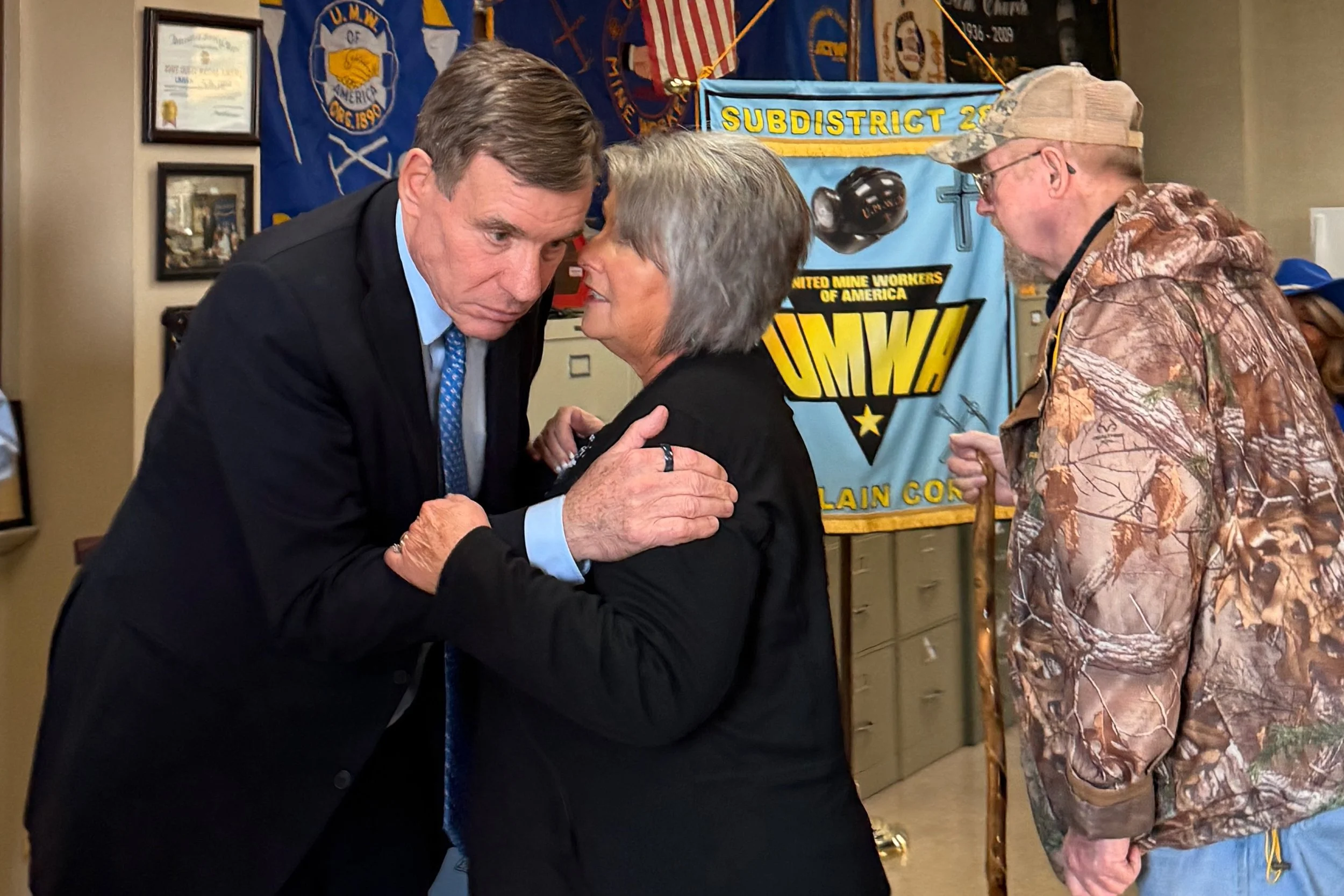
The day before announcing his reelection campaign in March, U.S. Sen. Mark Warner, D-Virginia, meets with Vonda Robinson, president of the National Black Lung Association as well as United Mine Workers of America representatives, healthcare workers, lawyers and miners at the UMWA office in Castlewood, Virginia. Photo by Christopher Tyree // VCIJ
The Constitution’s framers battled over the structure of the U.S. Senate and how its members would be chosen
By Philip Shucet
U.S. Sen. Mark Warner is asking Virginians to send him back to Washington again. If they do, Warner said, it will be the last time.

“Respectfully, I'm asking folks to hire me, but I don't want to pretend that this is not my last term,” the Democrat and former governor said in July. Warner, 71, faces Republican Bert Mizusawa on Nov. 3.
If reelected, Warner will represent 8.6 million Virginians. A senator from Wyoming represents about 577,000. In the Senate, their votes count the same.
That arithmetic has made the Senate a growing target. Every state gets two senators, regardless of population. The 26 least populous states hold 52 seats, a majority, with less than 18% of the nation’s people, according to the 2020 census. The nine most populous states, home to more than half of all Americans, hold 18 seats.
Republicans control the Senate 53-45, with two independents caucusing with Democrats. Credit each senator with half of a state’s population, splitting states such as Pennsylvania and Wisconsin that send one of each, and the 53 Republicans represent about 151 million people. The 47 Democrats and independents represent about 180 million.
Critics call the structure anti-democratic. Sanford Levinson, a University of Texas law professor, has called the Senate “the worst sort of affirmative action program for the residents of small states.” In 2007, University of Virginia political scientist Larry Sabato proposed giving the 10 most populous states two more senators each and the next 15 one more. Virginia would have three.
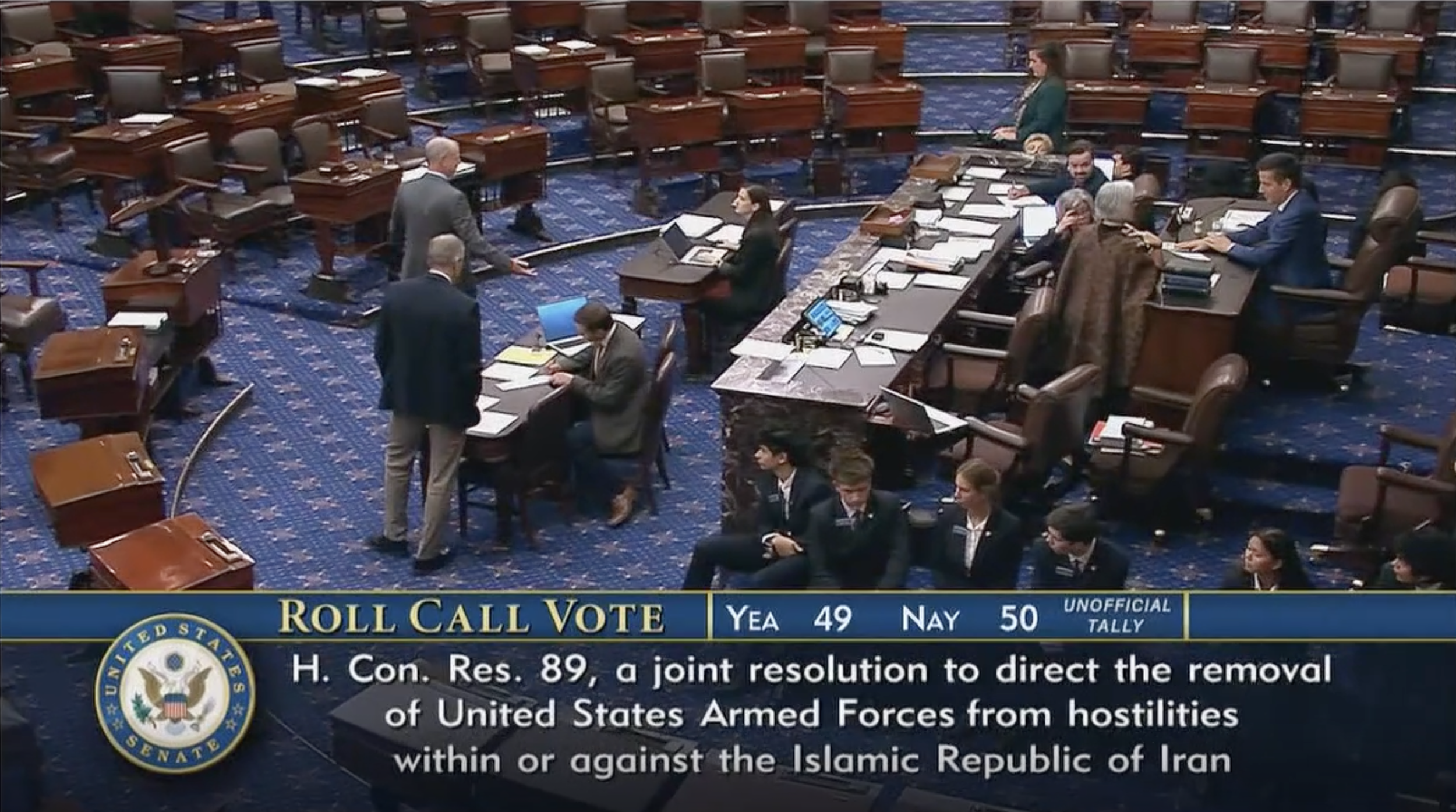
Frame grab from recent Senate vote on the Iran War.
Rep. Keith Self, R-Texas, would move in a different direction. His resolution, filed in June, would repeal the 17th Amendment and return the choice of senators to state legislatures. “If senators are supposed to represent their states, then the states should choose them,” Self said.
These arguments are not new. How senators would be chosen, and whom they would represent, divided the Constitutional Convention in 1787. The framers' answers look different today.
Virginia Gov. Edmund Randolph addressed the debate early in the convention. The country's troubles, he said, traced to “the turbulence and follies of democracy.” Some check was needed, and “a good Senate seemed most likely to answer the purpose.”
James Wilson of Pennsylvania wanted the people to elect senators. “If we are to establish a national Government, that Government ought to flow from the people at large,” he told the convention. The same day, the delegates voted 10-0 in favor of a motion by John Dickinson of Delaware for senators to be chosen by the state legislatures.
The harder question was representation. Virginia and the other large states wanted Senate seats apportioned by population. The small states demanded an equal vote. That debate nearly derailed the convention.
“Can we forget for whom we are forming a Government? Is it for men, or for the imaginary beings called States?” Wilson asked.
Rufus King of Massachusetts warned against sacrificing a just government “to the phantom of State sovereignty.” Oliver Ellsworth of Connecticut answered that “the power is given to the few to save them from being destroyed by the many.”
On July 2, 1787, Ellsworth’s motion for an equal state vote in the Senate deadlocked 5-5, with Georgia delegates divided. Virginia voted no.
“We are now at a full stop,” Roger Sherman of Connecticut said.
Charles Cotesworth Pinckney of South Carolina proposed “a Committee consisting of a member from each State” to “devise & report some compromise.”
Elbridge Gerry of Massachusetts presented the committee's report on July 5. House seats would be based on population. In the Senate, “each State shall have an equal vote.” In exchange, bills to raise or spend money would start in the House. The committee offered the compromise “on condition that both shall be generally adopted.”
On July 16, the delegates adopted the package, 5-4, with Massachusetts divided. Virginia voted no.
“The vote of this morning,” Randolph said, “had embarrassed the business extremely.” William Paterson of New Jersey answered that the small states would accept no conciliation “on any other ground than that of an equality of votes in the 2d. branch.”
The Great Compromise held the convention together.
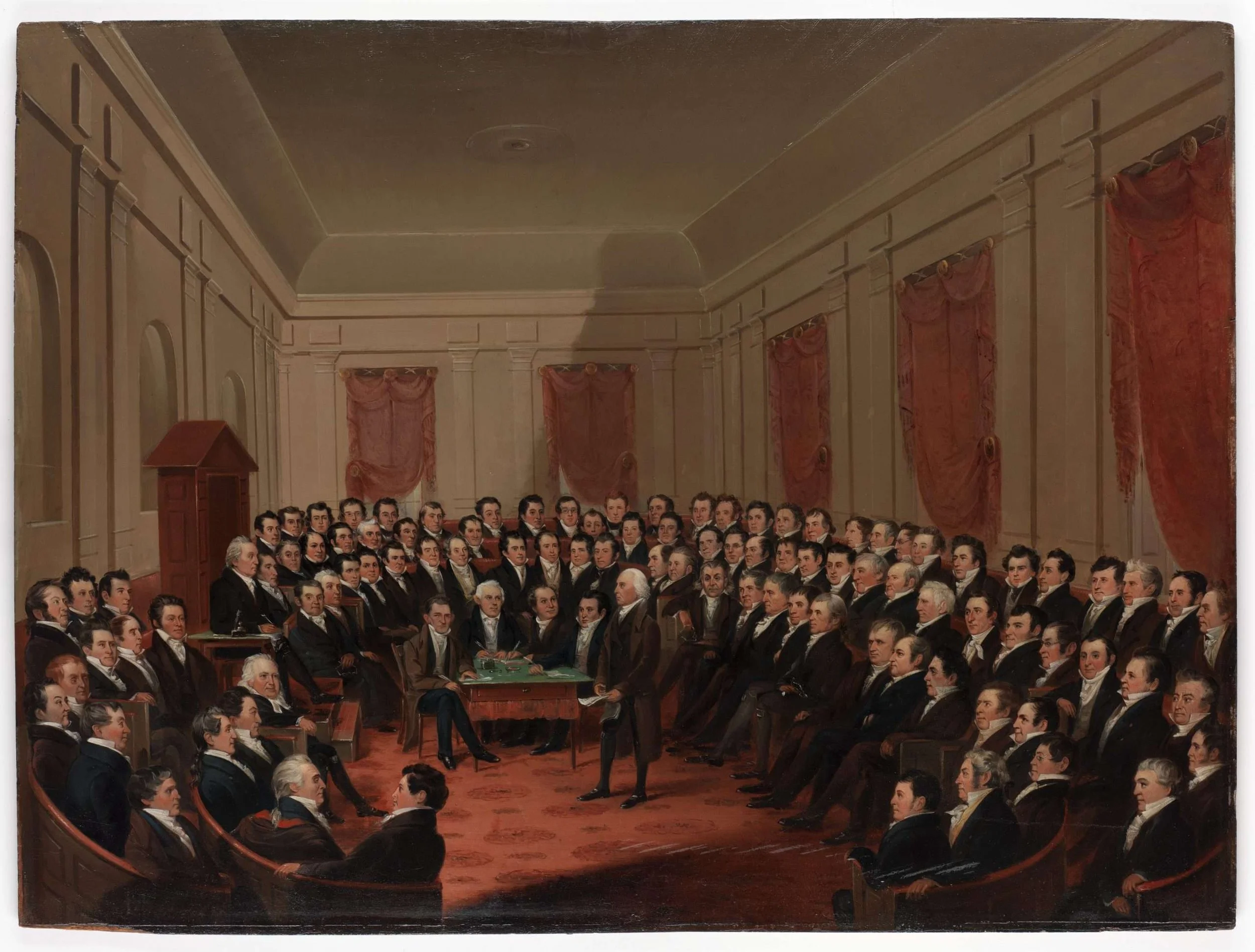
Former U.S. president James Madison, standing at center, addresses the delegates of the Virginia Constitutional Convention of 1829–1830. Among the delegates who gathered in Richmond were former presidents Madison and James Monroe, future president John Tyler, and Chief Justice John Marshall. The artist, George Catlin, made watercolor portraits of each of the 101 delegates in preparation for this oil painting of the entire group. ca. 1830
James Madison of Virginia told Thomas Jefferson that the small states had “made an equality in the Senate a sine qua non.” It passed, he wrote, “very much to the dissatisfaction of several members from the large States.”
In public, Madison defended the compromise. In Federalist No. 62 he called the equal vote “a constitutional recognition of the portion of sovereignty remaining in the individual States.” The large states could take this government or something worse. Prudence advised them “to embrace the lesser evil.”
At Virginia's 1788 ratifying convention, Randolph defended the Senate. “Who are your senators?” he asked. “They are chosen by the legislatures, and a third of them go out of the Senate at the end of every second year. They may also be impeached. There are no better checks upon earth.”
James Monroe disagreed. Senators, he said, could be punished by no one: “To whom are they amenable? I apprehend, to none.” Later he warned, “Seven states are a majority, and can in most cases bind the rest.”
George Mason, who had refused to sign the Constitution, objected and wrote that the senators “are not the representatives of the people or amenable to them.”
The Constitution was ratified without any change in the compromise that settled the composition of the Senate.
For 125 years, the General Assembly chose Virginia’s senators. Those legislators answered to a narrow electorate. In 1790, nearly 4 in 10 Virginians were enslaved. None could vote. Neither could women nor, until 1850, men who owned no land.
The General Assembly expected Virginia's U.S. senators to be faithful.
In 1836, it instructed them to vote to expunge the Senate's censure of President Andrew Jackson. Sen. John Tyler, who had voted for the censure, “refused to obey the instructions, resigned his seat, and returned home,” according to the federal compilation of presidential papers. Five years later, Tyler was president.
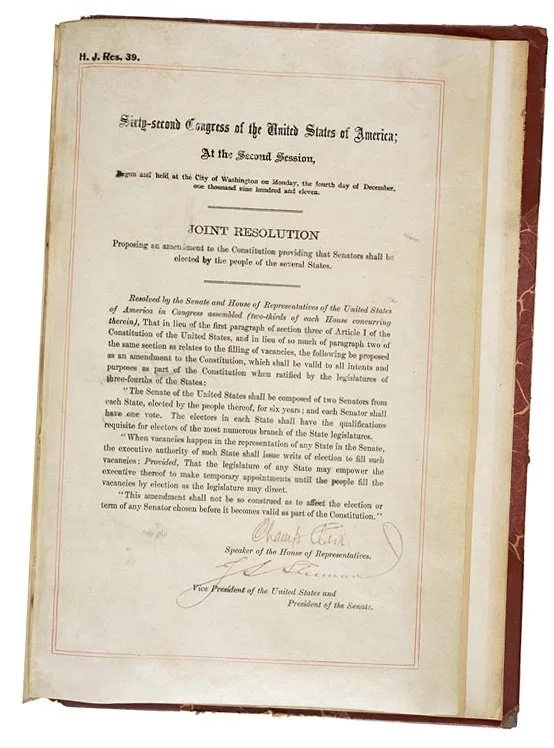
Joint Resolution proposing 17th amendment, 1913. Enrolled Acts and Resolutions of Congress, 1789. Source / National Archives.
Virginia’s Senate seats were in the hands of fewer than 150 legislators. In 1893, they chose Thomas S. Martin, a railroad lawyer little known outside party circles, over former Gov. Fitzhugh Lee. Lee had campaigned across the state. Martin had campaigned among the legislators whose votes counted. Critics charged that railroad money had bought the seat. A legislative committee cleared him, but Martin worked under that cloud for the rest of his career.
The 17th Amendment, ratified in 1913, struck “chosen by the Legislature thereof” from the Constitution and wrote in “elected by the people thereof.” Wilson's idea, which drew one state's vote in 1787, became law 126 years later.
The framers made sure the other half of their bargain would last. Article V of the Constitution provides that no state, “without its Consent, shall be deprived of its equal Suffrage in the Senate.” Reformers who want Senate seats to be apportioned by population have to find a way around that clause. None has found a way through it.
Wilson asked the convention whether the new federal government was for men or for “the imaginary beings called States.” Today the Senate straddles that line. Elected by voters, senators still equally represent the states.
The General Assembly that John Tyler defied has no say in Warner's race. Virginia's voters do. Whoever wins will cast one vote in 100, the same as a senator from Wyoming.
Paterson told the convention the small states would accept nothing short of “an equality of votes.” Under Article V, they will never have to.
Reach Philip Shucet at philip.shucet@philipshucet.com
Philip Shucet spent decades running large public institutions — the Virginia Department of Transportation and Hampton Roads Transit — during periods when they were under strain. He understands how they are built, how they break down, and what it takes to rebuild them. He is a graduate of Virginia Tech and the Columbia University Graduate School of Journalism. He has begun doctoral research in law and policy.