
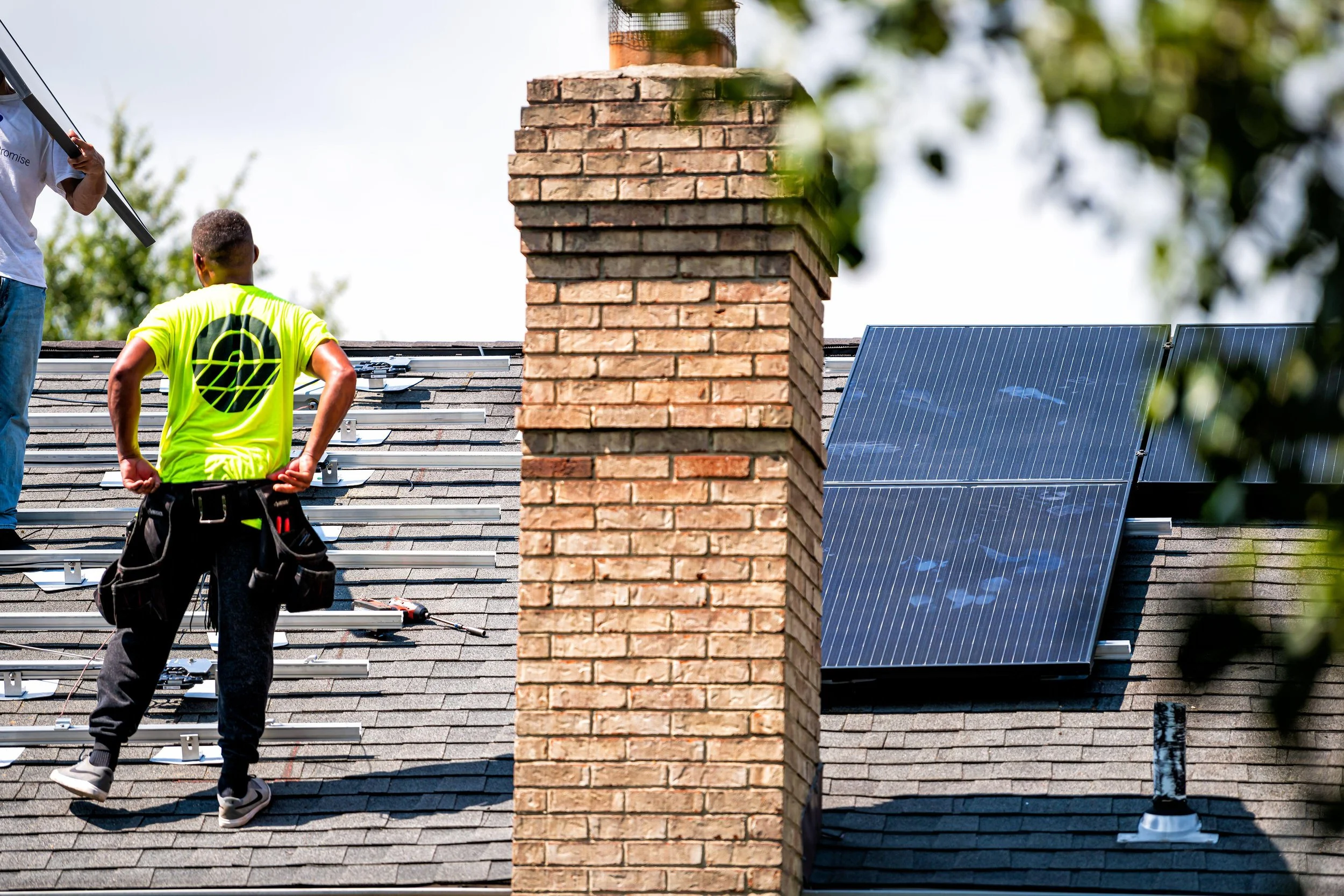
Both energy giants have a history of trying to make small, independent solar projects more costly for homeowners and businesses.
By Elizabeth McGowan
With a whopping 3,160 megawatts of solar across at least 27 states, NextEra Energy is the nation’s undisputed renewable power colossus.
Still, the Florida-based suitor of Dominion Energy has Virginia’s rooftop solar advocates on edge.
Why? Mainly because its principal investor-owned utility subsidiary, Florida Power & Light (FPL), has backed attempts to limit financial benefits customers can reap by owning small-scale solar systems.
One case in point is net metering —a popular program ushered into Virginia six years ago with passage of the landmark Clean Economy Act. It allows ratepayers with rooftop solar to earn electric bill credits by sending extra energy back to the grid.
FPL backed a measure Florida legislators passed in 2022 aimed at gutting the value of credits and charging homeowners a higher grid interconnection fee.
Republican Gov. Ron DeSantis vetoed it, citing the value of protecting savings for households. It’s unclear how much the law would have cost the average Florida homeowner because the measure was nixed before it could advance to the state’s utility regulators to reset the rate-of-return benefits.
“Everyone in my network is aware that Florida Power & Light is considered the most hostile with residential solar,” Robin Dutta, executive director of the Chesapeake Solar and Storage Association, said in an interview. “That’s their reputation.”
Neither NextEra nor FPL responded to requests for comment from the Virginia Center for Investigative Journalism at WHRO.
It’s no secret that FPL, Dominion—which has also attempted to stymie net metering in Virginia—and other investor-owned power companies are not fans of household solar because it doesn’t mesh with their traditional business model. They prefer to build and control large projects, allowing the costs to be folded into ratepayers’ bills.
Dutta’s trade group, which represents Virginia, Maryland and Washington, D.C., fears the commonwealth’s third-party, non-utility solar installers could be squeezed if regulators greenlight the $67 billion NextEra and Dominion merger proposed in mid-May.
The two energy behemoths submitted an application to the Virginia State Corporation Commission on July 15. That triggered a 60-day review, which utility regulators can extend by another 120 days.
Virginia’s progress on clean energy was one reason Democratic Gov. Abigail Spanberger cited in a Washington Post op-ed earlier this month for taking the unprecedented step of intervening in the merger case. The governor filed the intervention paperwork with the SCC on Monday.
“Any company that wants to own our state-regulated, largest utility must have a clear plan to accelerate progress toward producing affordable, reliable, local and clean power—not slow it down or trade it away,” she had written in the newspaper op-ed.
In addition, the acquisition requires approvals from shareholders of both companies, utility commissions in North and South Carolina, the Federal Energy Regulatory Commission and the Nuclear Regulatory Commission. Both Dominion and NextEra, who would serve roughly 10 million customer accounts in Virginia, the Carolinas and Florida, said the transaction could close by late next year.
Dutta said he’s being realistic about what’s at risk if watchdogs allow the spawning of what would be the country’s largest regulated power company.
“If you’re a smaller company and the only state you work in is Virginia, your livelihood could be under threat,” he said. “You might be asking, ‘Should I even stay in solar if I’m not set up to go to another state?’”
Ron Hisel, vice president of Charlottesville-based Tiger Solar, is a 17-year veteran of the industry. He said he wasn’t surprised that Dominion was open to an overture from a well-heeled and expanding energy company.
After all, he said, Dominion CEO Bob Blue has repeatedly stated that his utility alone can’t keep pace with the buying, building, financing and operating of the infrastructure needed to power the artificial intelligence and data center boom in its service territory.
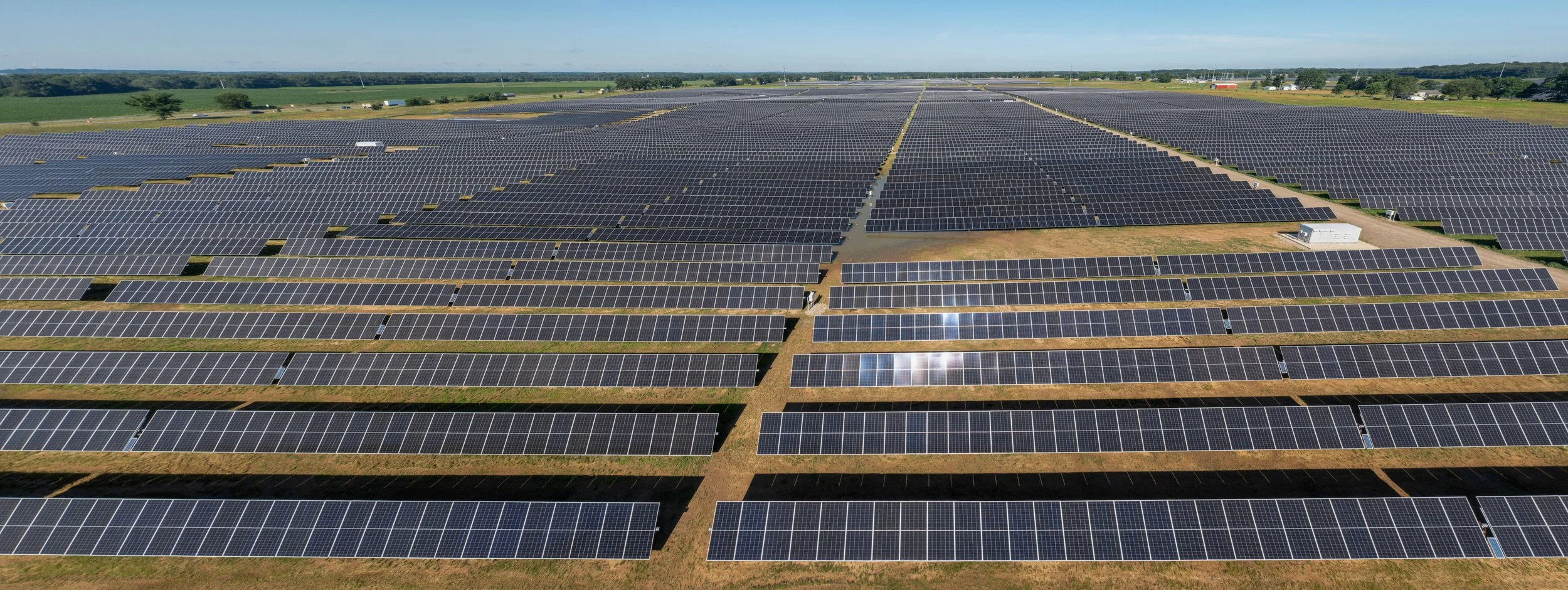
The Cereal City Solar project in Michigan, a 100 MW solar farm, is a project of NextEra Energy Resources, a major developer of renewable energy.
Hisel also pointed out that Virginia solar proponents had to fight back recently to prevent Dominion from slashing net metering benefits.
That pattern, he added, leads him to figure that Dominion would be “content to let NextEra be the bad guys by coming in, taking over and putting solar policies on hold. NextEra can say, ‘We’re the new company and we’re going to kill net metering.’”
When asked if the NextEra acquisition would prompt Dominion to backpedal on net metering, a spokesman cited recent testimony from Ed Baine, president of the utility’s Virginia division.
“The Company will remain fully dedicated to the nation-leading public policy priorities that Virginia has established, including through the Virginia Clean Economy Act,” Baine said in the merger petition filed in mid-July.
FPL solar setbacks go beyond net metering
Aaron Sutch is the Richmond-based regional director for Solar United Neighbors (SUN) in Virginia, Maryland, D.C., Florida and Puerto Rico.
While Dominion customers can’t shop around for a different utility, he said, they can mitigate soaring electric bills—the average one jumped 25% to 30% over the last three years—by seeking out the cheapest form of energy generation in rooftop solar.
“Net metering benefits everyone,” Sutch said. “It’s nothing more than leveraging a private investment in solar to meet the grid’s energy needs with low-cost clean fuel.”
Sutch and others breathed a sigh of relief in May when Virginia regulators struck down Dominion’s multi-pronged attempt to shrink net-metering rate-of-return benefits last year.
Briefly, the ruling means customers can continue to earn and roll over net metering credits over a 12-month annual cycle. That way, they have time to cash in on credits they accrue when their system produces extra energy in sunny months. The decision also prevented Dominion from reducing the net metering credit by almost one-third, from the full retail rate of $0.14 per kilowatt-hour to $0.095/kW.
Commissioners did allow Dominion to charge net-metering customers a $1-a-month administrative fee, far less than was originally proposed.
FPL’s efforts to shrink smaller-scale solar don’t end with its attempt to stifle net metering, said Shelby Green, a researcher for the Economic Policy Institute who focuses on investor-owned utilities in Florida and Virginia. EPI, a left-of-center think tank, is mostly funded by foundations and labor unions.
“People should be nervous about NextEra coming into Virginia because of its legacy at FPL,” Green said in an interview. “If this acquisition is approved, NextEra is a threat to the progress that Virginia has made with its climate and renewable energy initiatives.”
Indeed, the commonwealth’s clean energy advocates achieved momentum this year when legislators approved at least nine solar-centric measures aimed at helping homeowners and other small power generators save money and boost grid reliability.
Green noted that a decade ago, the nonprofit group Floridians for Solar Choice tried to amend the state constitution to allow significant savings for institutional solar clients.
These contracts, known as power purchase agreements, are advantageous to customers—often school districts, municipalities or nonprofit entities—because the developer arranges for the design, permitting, financing and installation of a solar array at little cost. Then, the customer buys the generated power at a fixed and lower rate. In return, the developer receives the income from electricity sales, in addition to tax credits and other incentives.
PPAs have been part of Virginia’s clean energy landscape since 2020. However, the attempt by the Florida nonprofit faltered when another group funded by FPL and other utilities countered with its own proposal. The whole effort failed.
Heaven Campbell, SUN’s program director in Florida, said FPL is also thwarting residential solar by requiring homeowners to buy commercial liability insurance for relatively small systems between 10 kW and 100 kW.
Almost 20 years ago, she explained, the state’s Public Service Commission logically ruled that customers opting for solar arrays needed homeowners’ insurance.
“So many people now decide not to go with solar because they can’t afford the 500 dollars a year for a commercial liability policy,” Campbell said about the loophole. “We have a lot of middle-class families trying to combat an affordability crisis. They don’t see the point of having savings on electricity eaten up by that extra policy.”
Research by EPI and others about the solar practices of NextEra and FPL, Green said, should be a red flag for Virginians in Dominion’s service territory.
“This brief history should be a signal to ratepayers in Virginia,” she said, “that they should want to keep this kind of behavior out of their state.
Reach Elizabeth McGowan at elizabeth.mcgowan@whro.org