
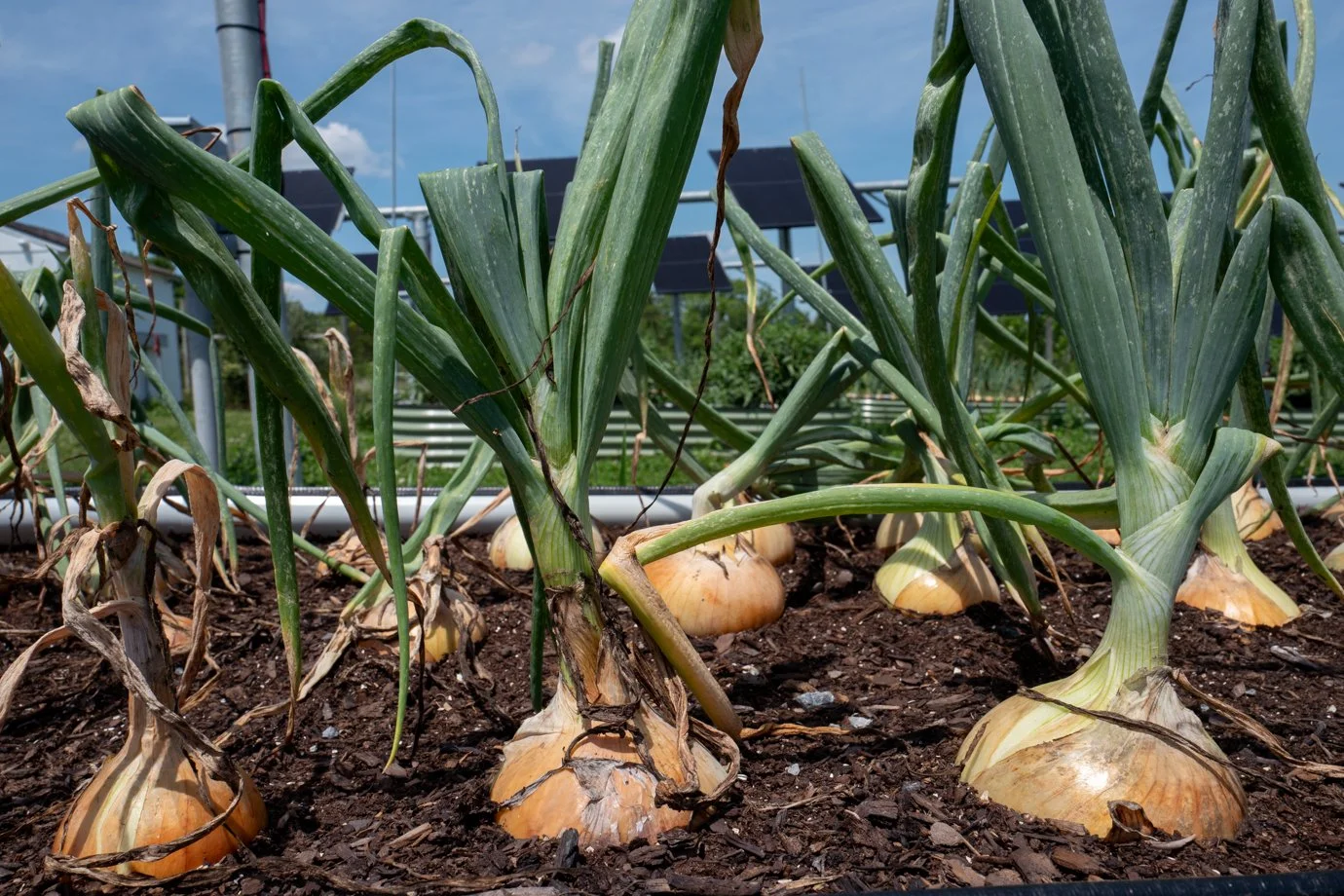
A new Virginia law encourages farmers to mix solar generation with crops and cattle. A rural pilot program shows promise.
By Elizabeth McGowan
Photography by Christopher Tyree
ALDIE, Va
Last autumn, a peculiar-looking crop sprouted on a Loudoun County clearing where cattle have grazed since the late 1700s.
This summer, curious farmers are still flocking to the undulating parcel of piedmont to investigate.
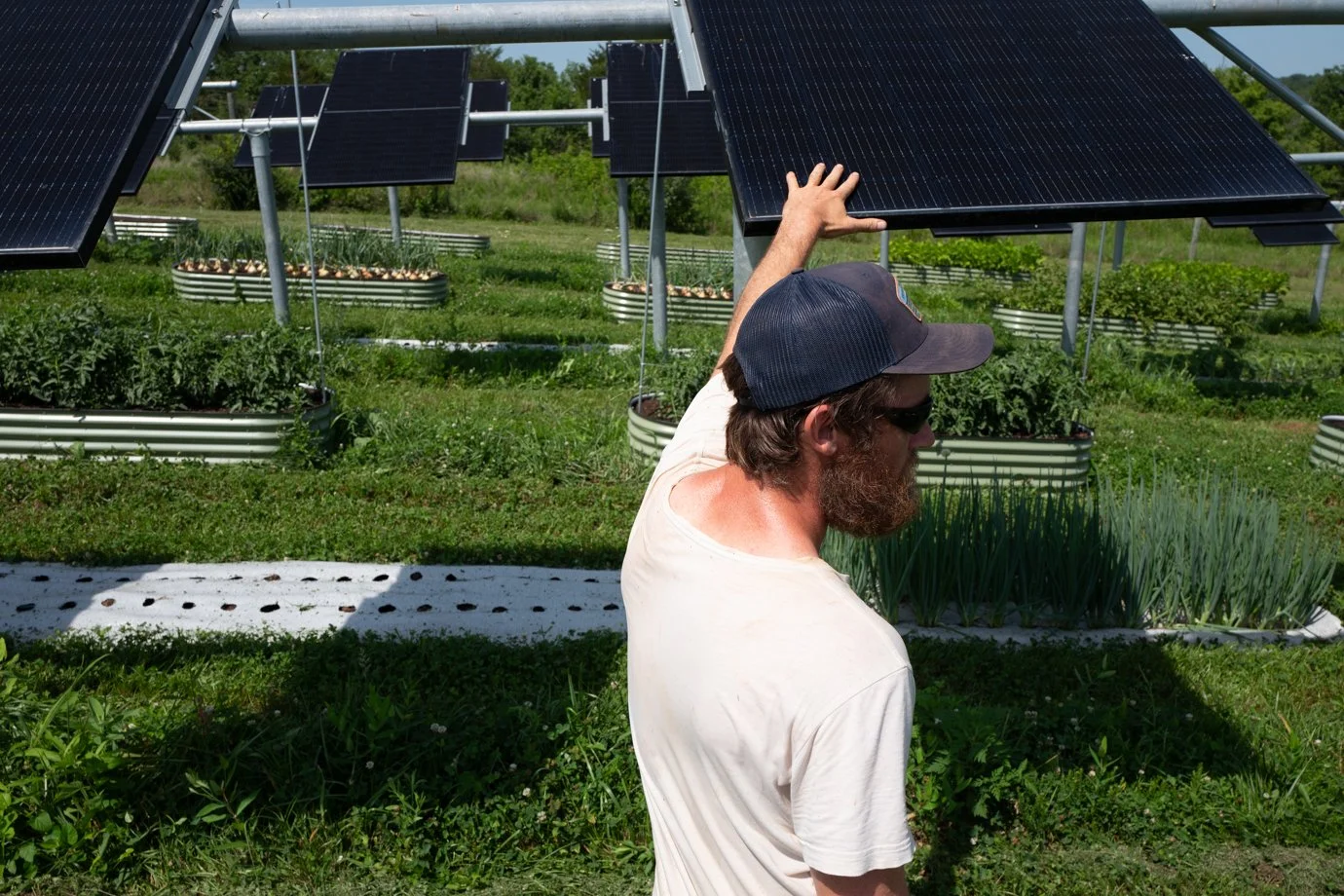
What’s the draw? Forty-two solar panels planted in neat rows. They’re strategically interspersed among raised and in-ground beds of vegetables flourishing at the Community Farm at Roundabout Meadows where Highway 50 meets Highway 15.
The eight-acre farm is the first place in the commonwealth where solar energy is being integrated with crop-based agriculture. The whole point of the unique combination is to demonstrate how the two industries can exist in harmony, not discord.
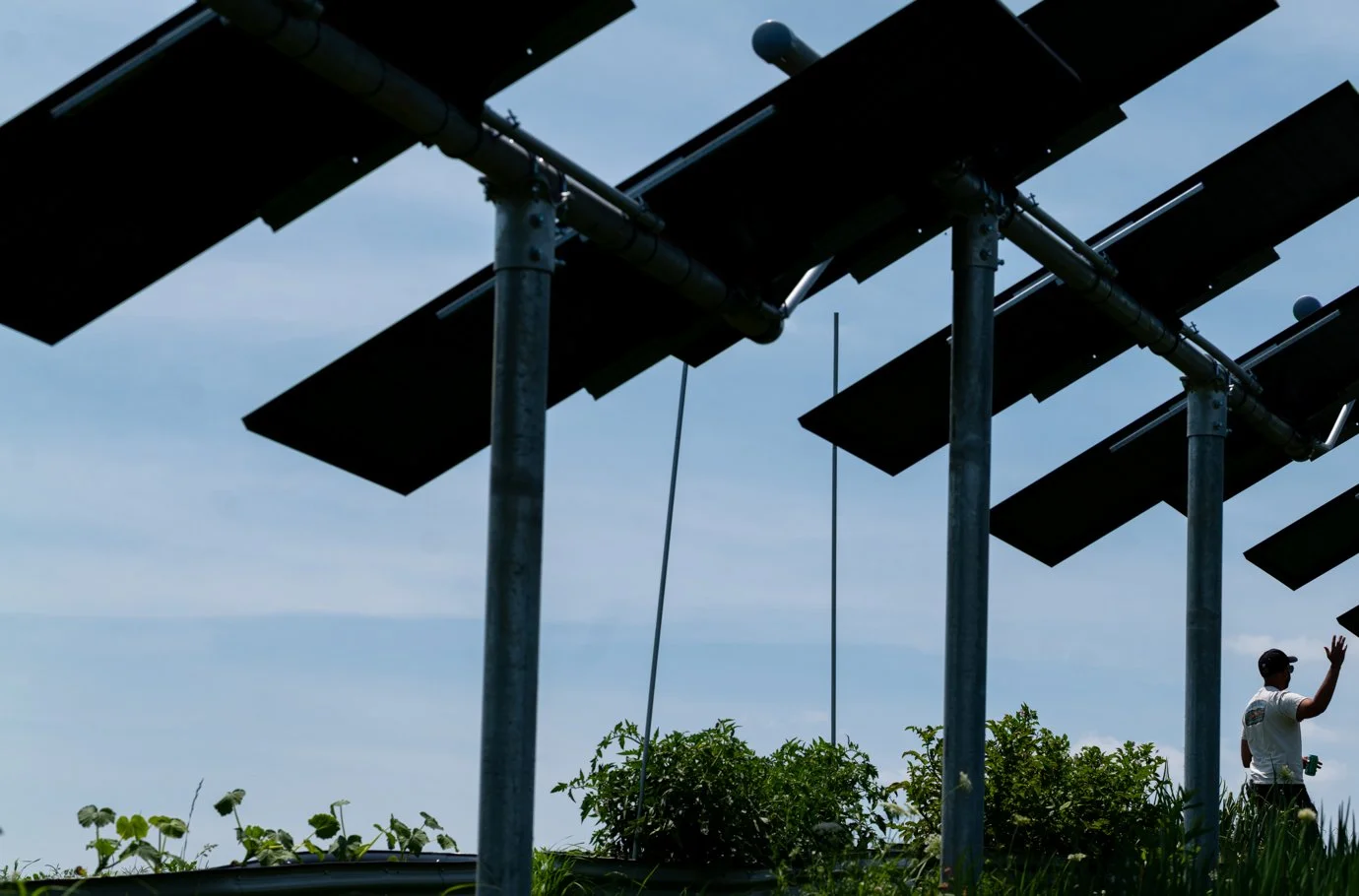
Ashish Kapoor, Piedmont Environmental Council’s senior energy and climate adviser, explains how this project puts farmers and solar developers on common ground.
It’s the brainchild of the Piedmont Environmental Council, a Warrenton-based land trust devoted to healing a painful rift between solar developers dedicated to clean energy and farmers fearful of sacrificing their livelihoods.
Tense, heated, either-or arguments had exhausted Ashish Kapoor, PEC’s senior energy and climate adviser.
“We found a lot of buy-in when we listened to all voices, discovering there’s a lot of nuance between slowing climate change and preserving viewsheds,” he said while walking on a mowed pathway under the Roundabout panels on a mid-July day.
Large-scale solar had become a lightning rod in rural Virginia over the last decade. Counties began fighting back with solar bans and other strict regulations as the clean energy industry pursued enormous swaths of remote Virginia properties to fuel the explosion of power-hungry data centers in the D.C. metro region.
Farmers faced a conundrum. The money they could earn for leasing their land to developers was appealing. Yet they also sympathized with neighbors who resented solar arrays covering pastures and former soybean and corn fields.
Still, farmers weren’t anti-solar. Indeed, 53% of the Virginia farmers and landowners surveyed in 2024 had told the American Farmland Trust’s Mid-Atlantic team that they would consider solar if farming could continue under and around panels.
“We wanted to shift the tenor of the conversation,” Kapoor said about seeking compromise. “I just don’t think people want to be against things all the time.”
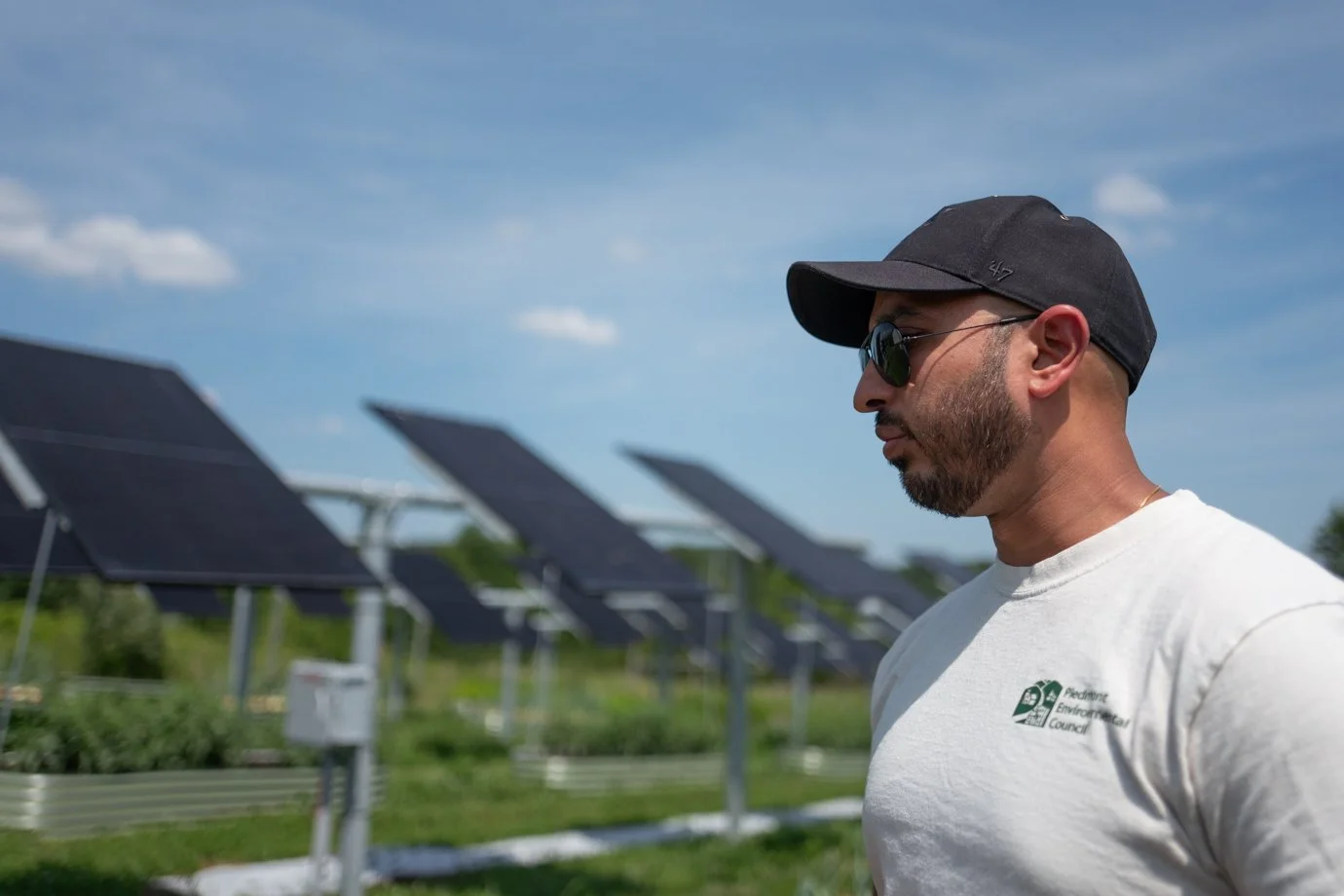
Ashish Kapoor, PEC’s senior energy and climate adviser.
That open-minded approach has had a cascading effect. First, it propelled PEC toward investing $120,000 of its own money into an on-the-ground solar showpiece on a farm it had purchased eight years ago.
“The optics of Roundabout are convincing,” Kapoor said. “It’s two conflicting ideas working together.”
His willingness to gather input from farmers also opened negotiations on a new piece of legislation that spells out how farmers can pair crops or creatures with solar panels.
Democratic Gov. Abigail Spanberger traveled to Roundabout in mid-June to ceremonially sign the agrivoltaics bill into law, which went into effect July 1.
One of Kapoor’s chief collaborators on advancing the legislation was Rachel Henley, a Virginia Farm Bureau lobbyist.
“We were pushing and fighting for farmers to have a seat at the table instead of being told what to do,” Henley said in an interview. “It’s so wonderful to find opportunities where we can find consensus.”
Earlier, she said, she had been disenchanted with how solar developers, intent on maximizing energy production, dismissed farmers’ input.
Now, she said, it’s clear farmers can earn income from a developer for leasing their land while continuing to raise crops or animals. That punches a farmer’s ticket to energy independence and smaller utility bills.
“With dual use, done in the right way, it’s a win-win,” Henley continued. “It’s an awareness issue. We keep a rural economy and add more value to the land.”
For farmers, ‘seeing is believing’
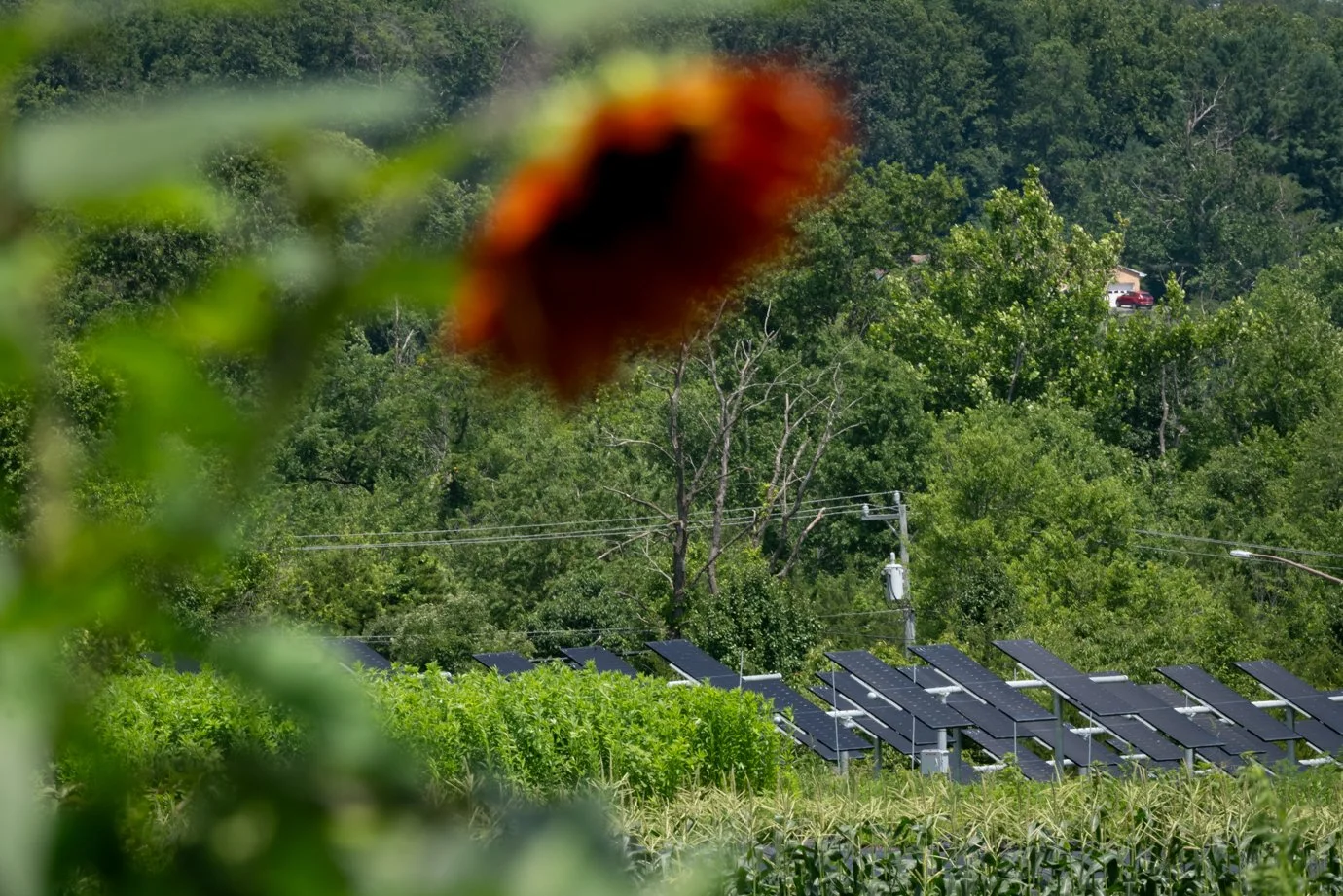
Solar panels mix with crops planted at PEC’s Roundabout Community Farm, part of a larger stewardship project that began in 2018.
Roundabout Community Farm is part of 172 acres known as Gilberts Corner that PEC bought for various stewardship projects in 2018. Teddy Pitsiokos has managed the nonprofit Roundabout for the past four years.
He oversees the year-round planting and harvesting of 30-plus types of vegetables, all donated to five regional food pantries. That’s supplemented by crops of berries, as well as apples, plums, peaches, cherries and pears grown on on-site orchards.
Roundabout donates 60,000 pounds of produce annually, a tenfold increase from 2018.
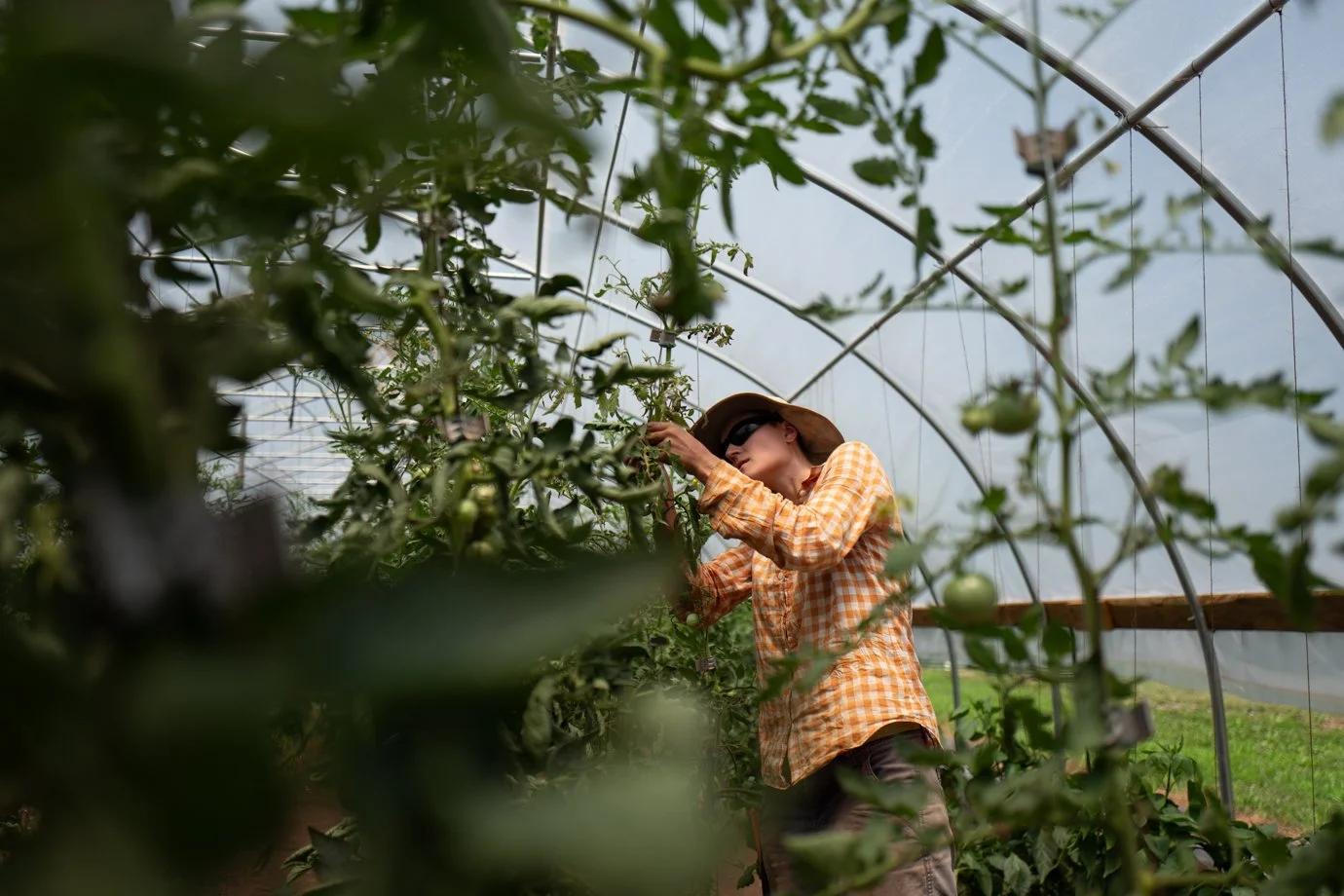
However, his earlier experience in the for-profit farming sector makes him empathetic to his brethren’s questions about mingling panels with animals or crops. The potential slip in crop yields isn’t an option when margins are already slim, he said.
“I tend to be skeptical of change,” Pitsiokos said. “But when offered the opportunity to do something new like this, I was super-excited. The results have been great.”
The relatively small 17 kilowatts of electricity cranked out by the south-facing panels on a quarter-acre of the farm can power the whole operation. Additionally, up to 23 kW of energy can be stored in and pulled from two batteries housed in a nearby shed.
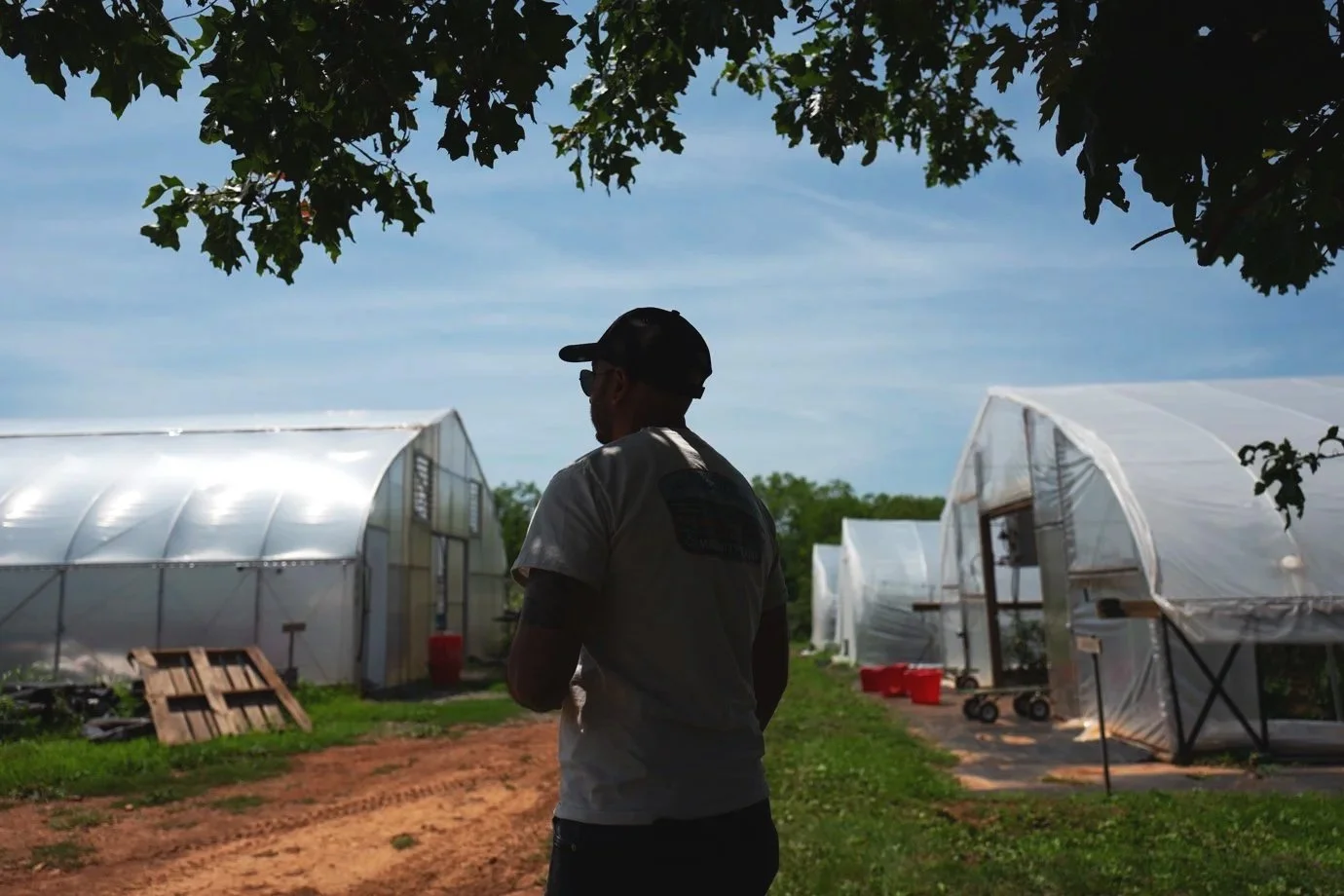
“That covers all our essential services,” Pitsiokos said, referencing a well pump for watering, a walk-in cooler and ventilation for a hoophouse and a greenhouse.
Since the solar was installed last October, Roundabout’s monthly electric bill has plunged from roughly $200 to $14, the cost to maintain a grid interconnection with Dominion Energy.
As an extra measure, he’s begun tracking growth rates of scallions, celery, summer squash, carrots, beans, potatoes and other crops sometimes shaded by the panels.
Most satisfying is that the experiment is attracting a parade of hundreds of inquisitive visitors, including several dozen farmers and solar developers, that Pitsiokos sometimes feels more like a tour guide than a farm manager.
“Our people want to see stuff,” Henley said about the bureau’s 36,000 members. “Seeing is believing.”
Knowledge and numbers gathered at Roundabout can equip farmers with the right solar scenario to maximize crop production. That’s just what Tiger Solar had in mind when PEC hired the versatile Charlottesville-based entrepreneurs to build a passion project from scratch.
“It’s not meant to be a cookie-cutter,” said Ron Hisel, company vice president. “These can be custom-designed for each farm property and they can be affordable for farmers.”
Most rewarding, he said, was mixing and matching components that would minimize the footprint without displacing precious topsoil.
The bare-bones law Henley helped to shape prioritizes agricultural production, allows for continued sale of farm products and maintains flexibility for farmers.
Avoiding greenwashing and establishing clear guardrails were two objectives she and Kapoor insisted upon. “We wanted to ensure it moved agriculture forward,” Kapoor said. “If people exploit it by installing panels on a property and throwing sheep on it, that’s not agrivoltaics, that’s b.s.”
Large-scale arrays have put conservationists on edge. In 2022, worries about smaller projects displacing prime agricultural soils and forestlands prompted Virginia legislators to pass a law limiting photovoltaic panel footprints.
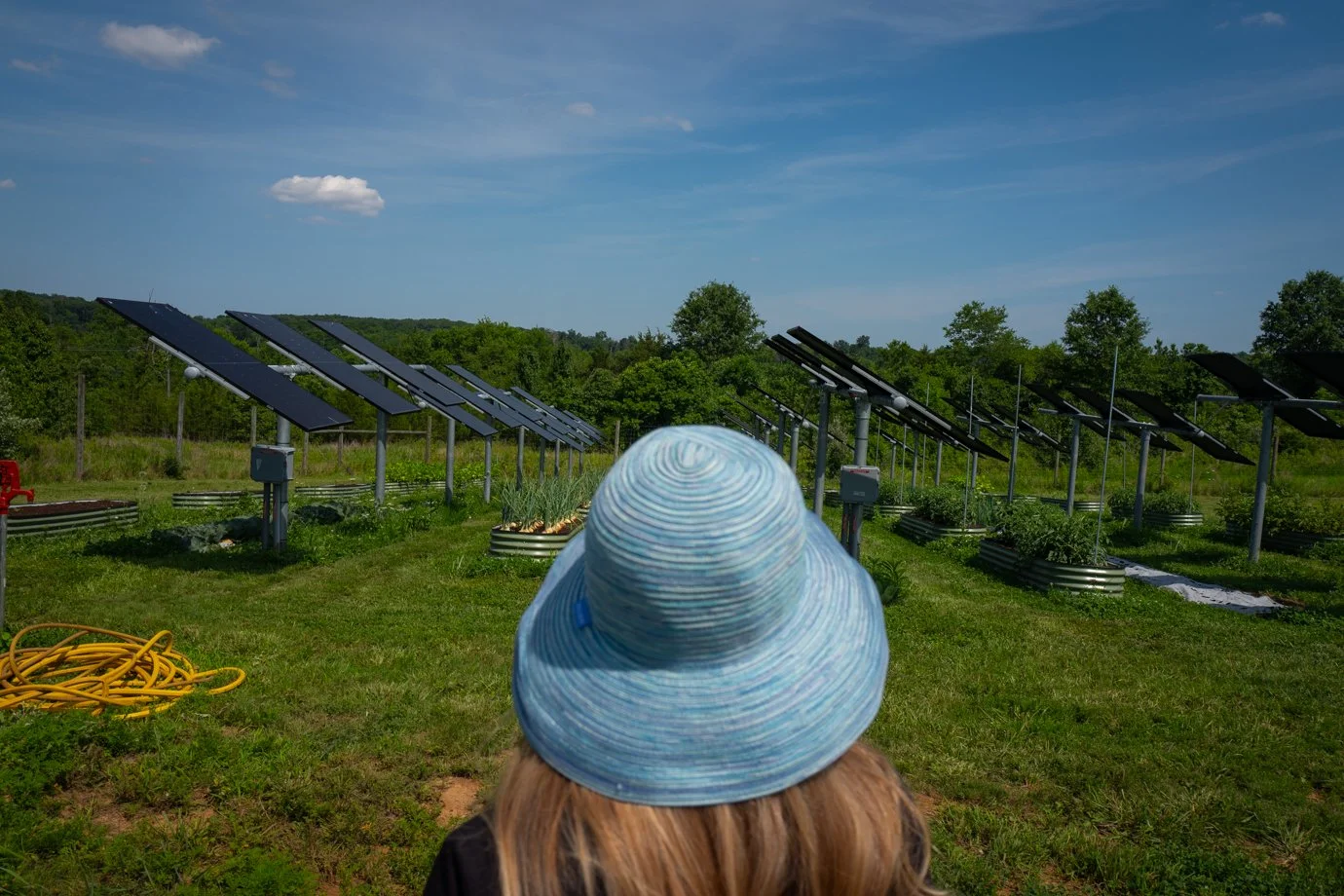
Piedmont Environmental Council’s Elizabeth Ransom surveys the solar field on the group’s Community Farm at Roundabout Meadows in Loudon County, July 13, 2026.
Bringing cattle farmers on board
Roundabout is the only crop-growing agrivoltaics farm among the 13 Virginia operations listed on a website compiled by the U.S. Department of Energy’s National Laboratory of the Rockies. Another five provide pollinator habitat and the remaining seven are dedicated to sheep grazing.
However, for solar and agriculture to co-exist and thrive, Virginia’s cattle and dairy farmers need to be recruited, Henley said. “We’re a beef cattle state, and we have a lot of dairies,” she said about a commonwealth with 1.3 million cattle and just 77,000 sheep.
“A lot of developers have told Virginia cattle farmers that solar isn’t going to work because it’s too expensive and cattle will destroy the panels. But that’s a myth. Those developers have never spent time around cattle.”
She and Kapoor are counting on data from Silicon Ranch, a solar developer with innovative projects nationwide, to provide data that debunks those misconceptions.
PEC estimates that Virginia farmers could generate 10,000 megawatts of power if just a quarter of the state’s 39,000 farms installed one megawatt (1,000 kW) of solar on roughly five acres.
That’s enough to power roughly 1.2 million homes across the state. It’s also a significant chunk of the 16,100 MW of solar the commonwealth is mandated to generate by 2035.
But the financial bonus is that those farmers would be able to cover other everyday expenses with the money they now budget for soaring electric bills. This spring, for instance, Virginia farmers paid $1,500 more than they did a year ago to refill their farm’s onsite fuel tank, according to a just-released congressional report.
For Kapoor, it’s a relief to have former adversaries unearth common ground—literally.
“We’ve seen what happened when everyone is yelling at one another,” he said, basking in the serenity of a 360-degree uninterrupted view. “My hope with this law is that the folks who actually want to combine solar and farming can make durable progress.”
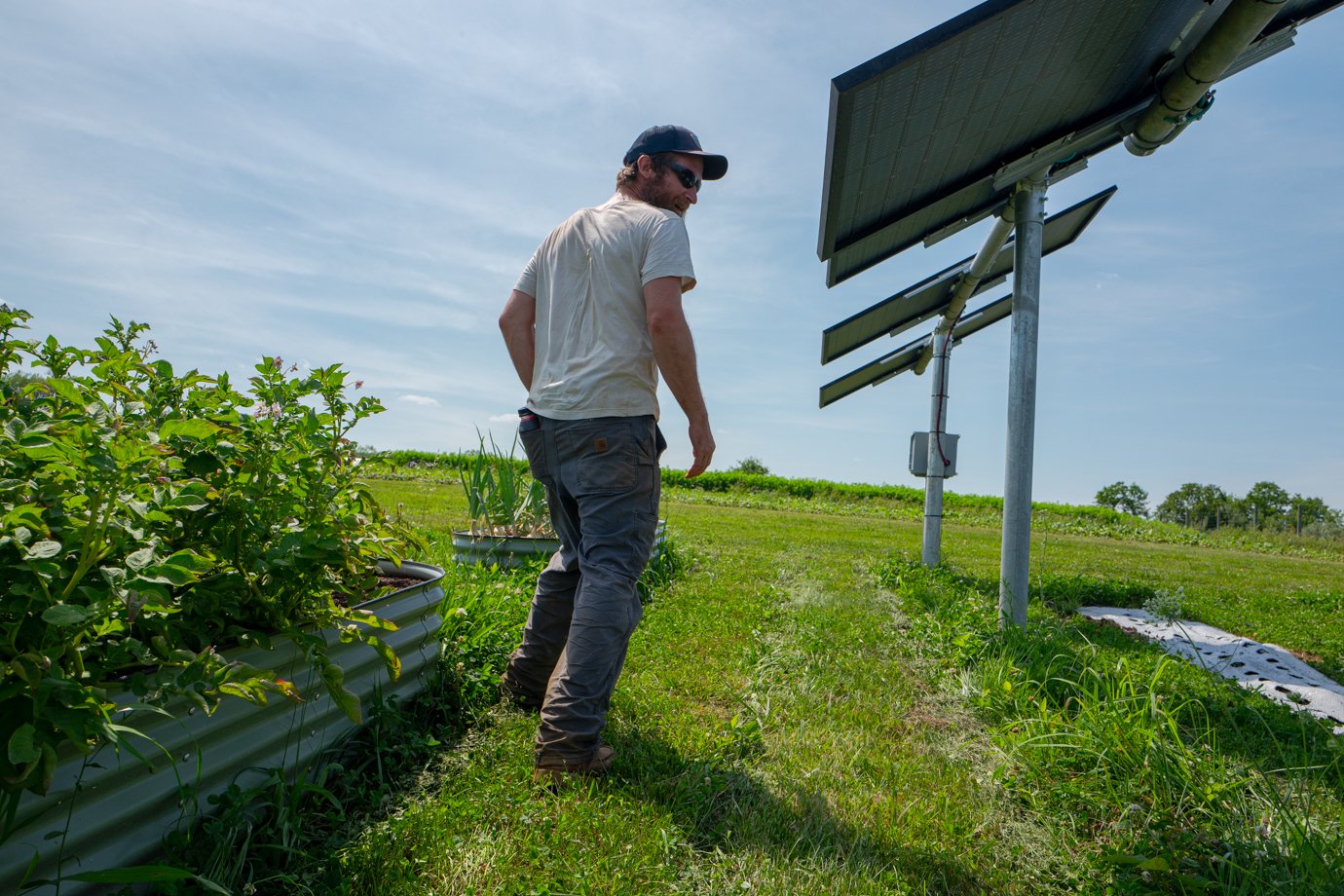
Teddy Pitsiokos inspects the crops growing under and between solar panels on the Roundabout Community Farm July 13, 2026.
Reach Elizabeth McGowan at Elizabeth.McGowan@whro.org.