
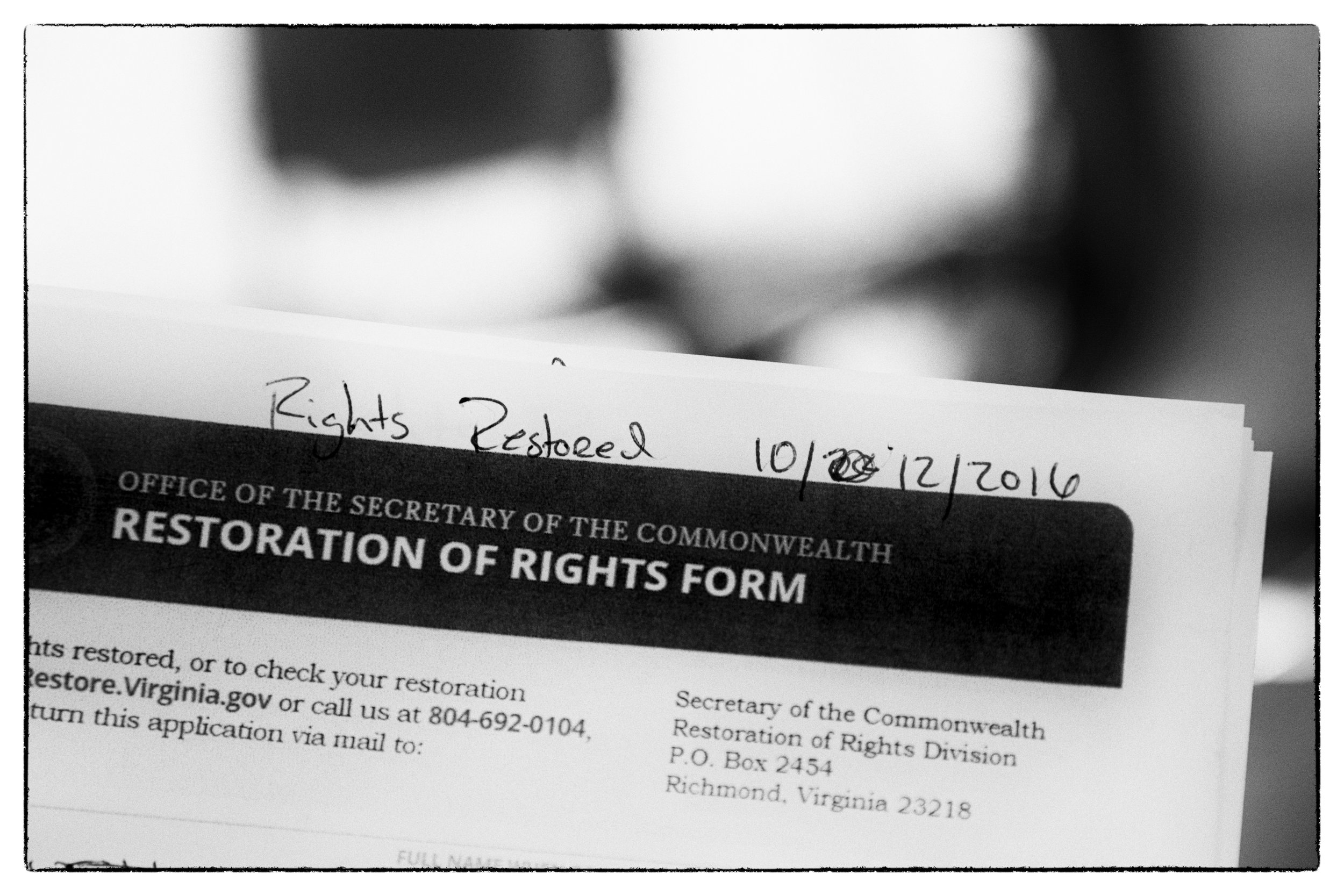
More than a quarter of a million voting-age Virginians last year were barred from the polls. They were once convicted of a felony, served their time and re-entered society – but not completely.
By Philip Shucet
More than a quarter of a million Virginian adults last year could not vote for a specific reason: they had been previously convicted of a felony, even though they had served their sentences.
Virginia is one of only three states where felons are permanently stripped of voting rights unless the governor decides to restore them. But in January, a federal judge ruled that Virginia had been illegally disenfranchising voters for 156 years.
U.S. District Judge John Gibney said that Virginia's felony disenfranchisement rule violates the Virginia Readmission Act of 1870, the law Congress passed to let the state back into the Union after the Civil War. A condition of readmission was that Virginia could strip voting rights only for a narrow list of 11 crimes that counted as felonies under common law at the time.
"For well over a century," Gibney wrote, "the Commonwealth of Virginia has disobeyed a federal law designed to protect the right of former enslaved people to vote."
This November, Virginia voters will consider a constitutional amendment that would automatically restore voting rights to anyone who completes a felony sentence. The proposed amendment has already cleared the General Assembly in back-to-back sessions.
More than two centuries ago, the framers debated the issue at the Constitutional Convention in Philadelphia. In our young democracy, who, they asked, should have the power to vote?
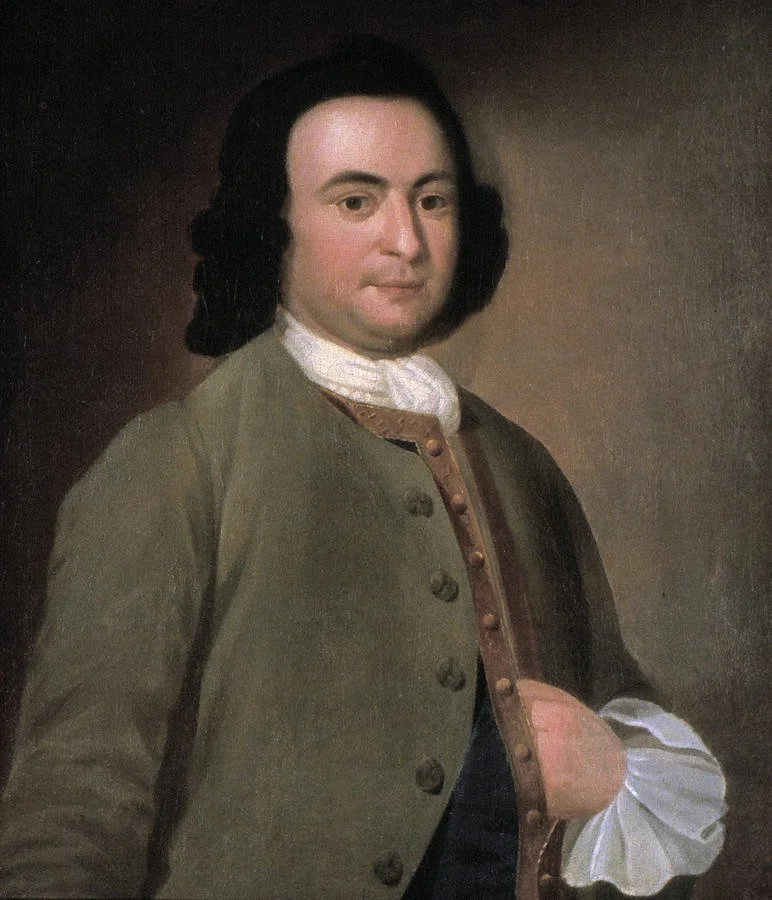
George Mason
The delegates at the convention had been raised on the idea that a republic survives only if its citizens possess the virtue to govern themselves. The idea reached back through Cicero's Rome and the philosophers who influenced the framers: John Locke, Montesquieu and David Hume. But for the right to vote, the delegates could not agree on how to define virtue.
The draft constitution put on the table suggested that voting rights for the national legislature, the House of Representatives, be left to the states.
Pennsylvania's Gouverneur Morris kicked off a debate by suggesting that voters' qualifications for the House be restricted to freeholders, those who owned property outright. "Give the votes to people who have no property, and they will sell them to the rich who will be able to buy them," Morris said.
Virginia's George Mason disagreed. A property test, in his view, was inherited class thinking with no place in a republic. "The true idea," he said, "was that every man having evidence of attachment to & permanent common interest with the Society ought to share in all its rights & privileges."
Mason had said nearly the same thing in the 1776 Virginia Declaration of Rights, later incorporated into Article I of Virginia's Constitution. Suffrage belonged to "all men, having sufficient evidence of permanent common interest with, and attachment to, the community."
Mason’s objection wasn't to property as a test, but to land as the only property that counted. "Does nothing besides property mark a permanent attachment?" he asked. Shouldn't the "merchant, the monied man, the parent of a number of children . . . be trusted with the common rights of their fellow Citizens?"
But the framers failed to agree on broad suffrage and left the question open to the states. Virginia's restriction of voting rights for property-owning white men stood.
At the 1788 Virginia ratification convention in Richmond, George Nicholas, a Federalist, defended leaving suffrage rules to the states. "The best writers on government agree that, in a republic, those laws which fix the right of suffrage are fundamental," Nicholas said. The proposed constitution's rule was "the most judicious that could possibly have been devised, because it refers to a criterion which cannot be changed." It was a curious argument for a man defending a document that was, at that very moment, rewriting nearly every feature of American government.
Mason continued to propose more liberal suffrage, but the ratification convention adjourned with the property restriction preserved. That requirement would not be dropped until 1850.

Freedmen registering to vote in 1870 in the first municipal election in Richmond, Virginia, held after the end of the Civil War. (Library of Congress)
Virginia's history is not clean.
Virginia restricted voting rights in 1830 when people convicted of "infamous" crimes were disenfranchised. After Reconstruction, the Commonwealth constructed a Jim Crow legal and political order, enforced at times through racial terror. It restored white supremacy in practice even where the Constitution forbade it in name.
But it was Virginia's constitutional convention of 1901-02 that turned disenfranchisement into a weapon.
Convention leader state Sen. Carter Glass, a Lynchburg journalist turned politician, proposed a suffrage amendment directly aimed at removing Black Virginians from the electorate through poll taxes, literacy tests, and an "understanding clause" that could be administered at the discretion of local election registrars. The list of voting disqualifications was also expanded to include any felony conviction. Black voter registration in Virginia fell from roughly 147,000 to 21,000.
Asked if his proposals were discriminatory, Glass said, "Discrimination! Why, that is precisely what we propose; that, exactly, is what this Convention was elected for—to discriminate to the very extremity of permissible action under the limitations of the Federal Constitution, with a view to the elimination of every negro voter who can be gotten rid of, legally, without materially impairing the numerical strength of the white electorate."
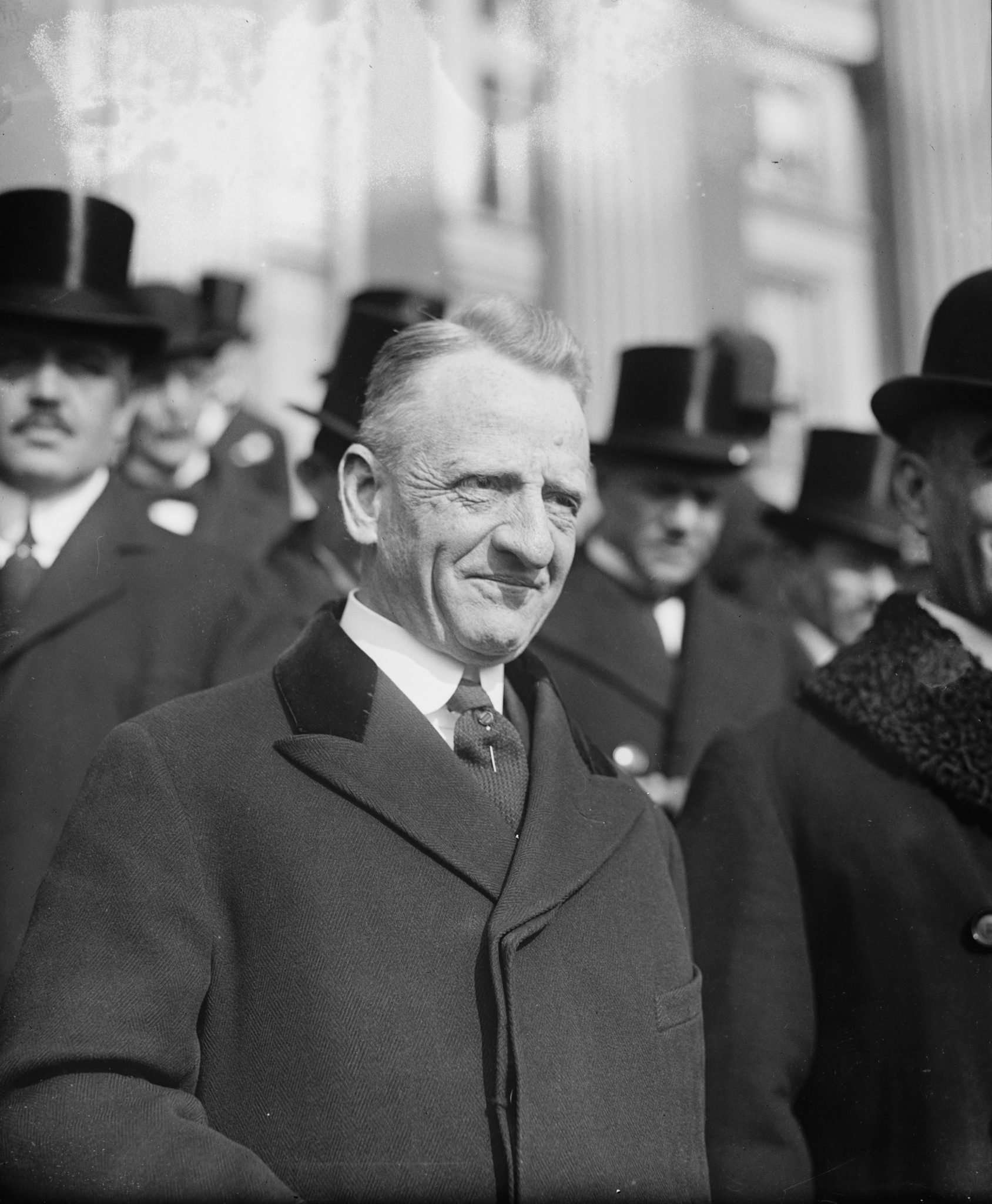
Surrounded by men in top hats, Virginia congressman Carter Glass stands at center in this photograph taken between 1918 and 1920. Library of Congress Prints & Photographs Division
Mason's language had been turned inside out. Virginia went along with Glass and later rewarded him with a seat in the House of Representatives and the U.S. Senate.
But Mason's and the framers' hands were not clean either. They had fallen short of actually governing according to the language they developed for the new country. The Constitution partially counted enslaved people for representation purposes but denied them the vote. Women were not mentioned, and every state at the time read that silence as exclusion from the vote.
Mason’s original language, read on its face, would have qualified Black voters. But Mason himself kept more than 100 slaves on his plantation and did not free them.
The Constitution also provided the tool — amendments — that eventually undid those exclusions. In 1870, the 15th Amendment barred racial discrimination in voting, although Virginia spent decades finding ways around it. The 19th Amendment did the same for women in 1920. The 24th Amendment outlawed the poll tax in 1964. And in 1971, the 26th Amendment lowered the voting age to 18.
Today, Virginia's population of disenfranchised voters is the nation's fourth highest.
These formerly incarcerated citizens must still rely on the good graces — and fickle politics — of the governor to have their voting rights restored.
In July, Gov. Abigail Spanberger, a Democrat, restored voting rights to more than 66,000 Virginians who were once incarcerated and had served out their sentences. Her Republican predecessor, Glenn Youngkin, had restored rights to fewer than 10,000 across four years.
This November, Virginians could pass a state constitutional amendment to restore voting rights to all felons who have been released from incarceration.
A constitutional amendment could hand Virginia a clean slate.
Reach Philip Shucet at philip.shucet@philipshucet.com
Philip Shucet spent decades running large public institutions — the Virginia Department of Transportation and Hampton Roads Transit — during periods when they were under strain. He understands how they are built, how they break down, and what it takes to rebuild them. He is a graduate of Virginia Tech and the Columbia University Graduate School of Journalism. He has begun doctoral research in law and policy.