
The planned acquisition of Dominion Energy by NextEra Energy brings together two multi-billion-dollar utilities. Here’s how they compare, and what consumers might see ahead
By Kunle Falayi
NextEra Energy’s acquisition of Dominion Energy, if approved, would dramatically increase the company’s customer base to about 16 million electric utility customers, making it the largest investor-owned utility in the U.S.
NextEra Energy’s acquisition of Dominion Energy, if approved, would dramatically increase the company’s customer base to about 16 million electric utility customers, making it the largest investor-owned utility in the U.S. It already is the most valuable electric utility in the world by market capitalization.
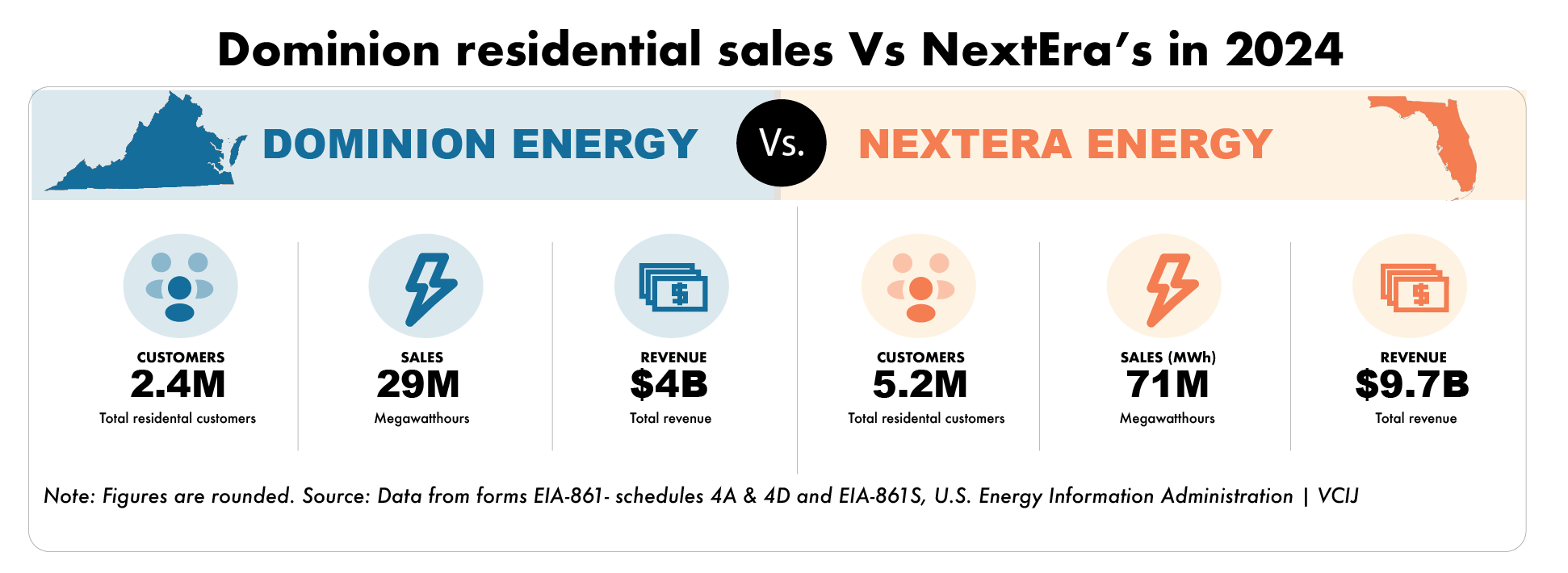
Florida Power & Light, NextEra’s regulated electricity provider, currently serves about 12 million people in Florida. Dominion provides electricity to 4.1 million customers across Virginia and the Carolinas.

But for Virginians, the central question is simple: Will this make electricity cheaper or more expensive?
Virginia’s regulation of the energy sector should ease customer concerns over dramatic rate changes, said João‑Pedro Ferreira, acting director of the Weldon Cooper Center for Public Service.
“We are already operating under a monopoly market,” he said, adding that customers cannot choose their energy company. “I don't think we are going to see a sudden shift in the costs. At least nobody can say if the costs are going up or down.”
To see how NextEra residential electricity customers fared in Florida compared to Dominion customers in Virginia, the Virginia Center for Investigative Journalism at WHRO examined how much electricity cost in both states.
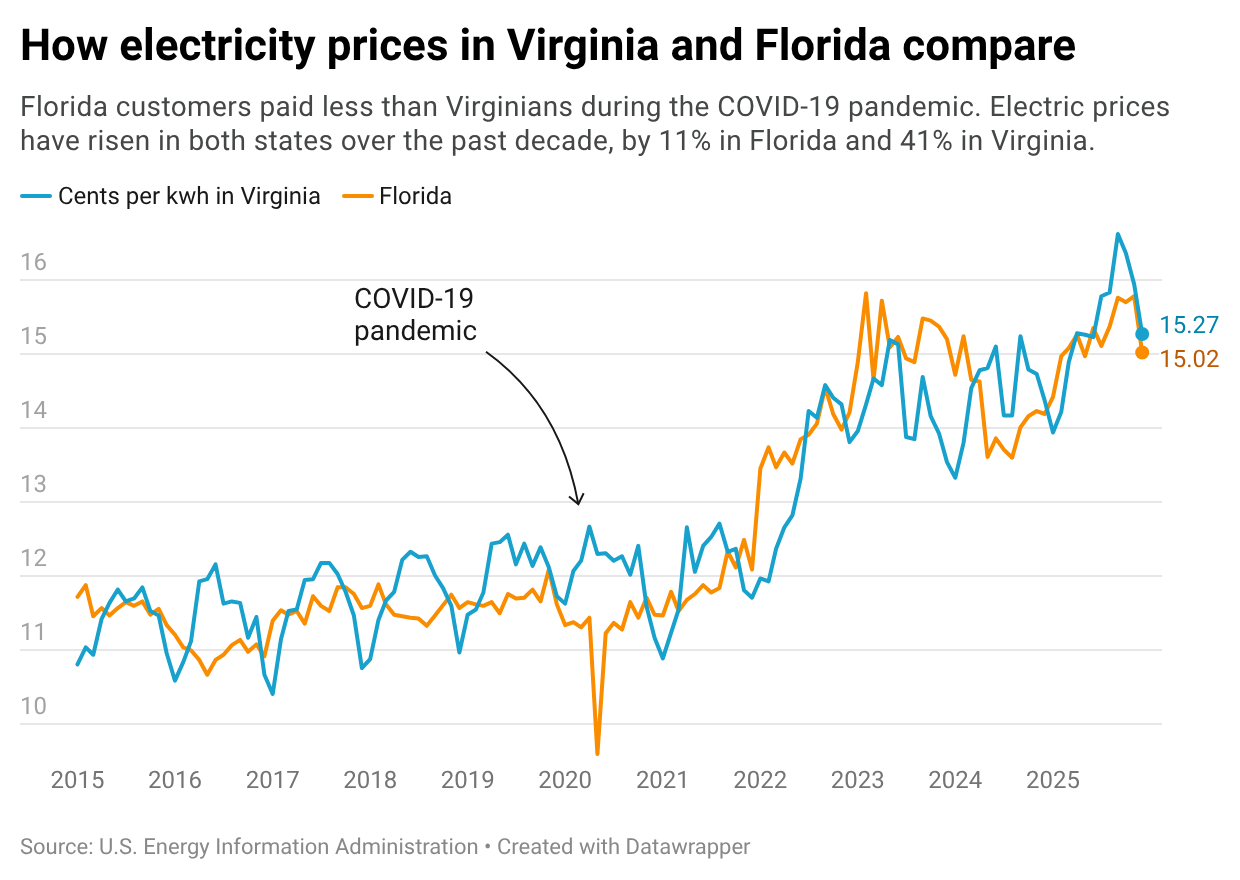
In Florida, where NextEra’s subsidiary, Florida Power & Light Company, supplies about half of the electricity in the state, residential customers paid an average of 15.23 cents per kilowatt-hour in 2025, according to the U.S. Energy Information Administration. Virginia customers paid slightly more: 15.38 cents per kilowatt-hour or 1,000 watts of power used continuously for one hour.
NextEra’s subsidiary, Florida Power & Light Company, sold electricity to its residential customers at an average price of 13.71 cents/kWh in 2024. Dominion’s Virginia Electric Power Company charged 14.09 cents/kWh.
The average residential consumer cost of electricity in Virginia is below the national average. Virginia ratepayers ranked 25th among all states in average residential electricity cost.
Idaho had the lowest average residential rate at 11.88 cents, while Alaska topped the list at 26.2 cents per kilowatt‑hour.
Florida was the seventh‑warmest state in the country in 2025, with an average maximum temperature of 83.1°F. Virginia’s average maximum temperature was 66.6°F.
But Florida’s hotter climate does not necessarily mean its consumers use more electricity than Virginia’s, Ferreira said. Climate plays a small role in the price of electricity, he said.
“It is true that Florida is much warmer, so you will have to use your ACs a lot, particularly in the summer,” he said. ”It also tells you that you can turn it off during many parts of the winter. In Virginia, you need a lot of heating in the winter and cooling in the summer. At the end of the day, it is almost like six months of high demand and six months of low demand, the same way that Florida is.”
The most important determinant of pricing in regulated electricity is how it is generated, he said.
A 2019 study by the Institute for Energy Research shows that new combustion turbine gas power plants produce energy at a cost of over $180 per megawatt-hour. New wind and solar produce energy at about $89 per megawatt-hour.
Capacity and renewables
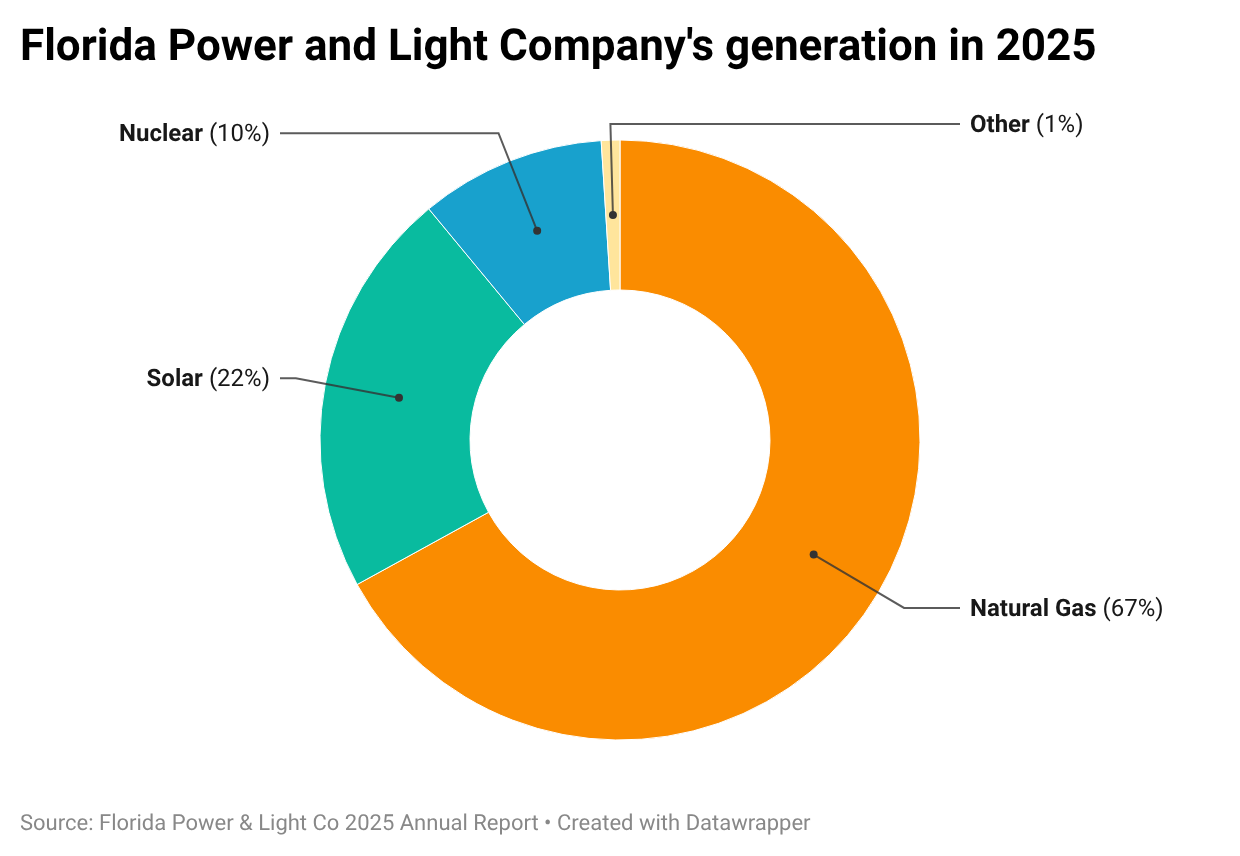
NextEra considers itself a national leader in renewable energy generation. Last year, the company reported that 22% of its generating capacity – over 8 gigawatts of electricity – came from solar alone.
Renewable energy from all utility providers supplied 12% of Florida’s electricity, according to the EIA. Most of that energy came from solar.
In Virginia, on the other hand, 14% of total electricity generated came from renewable energy, according to the EIA.
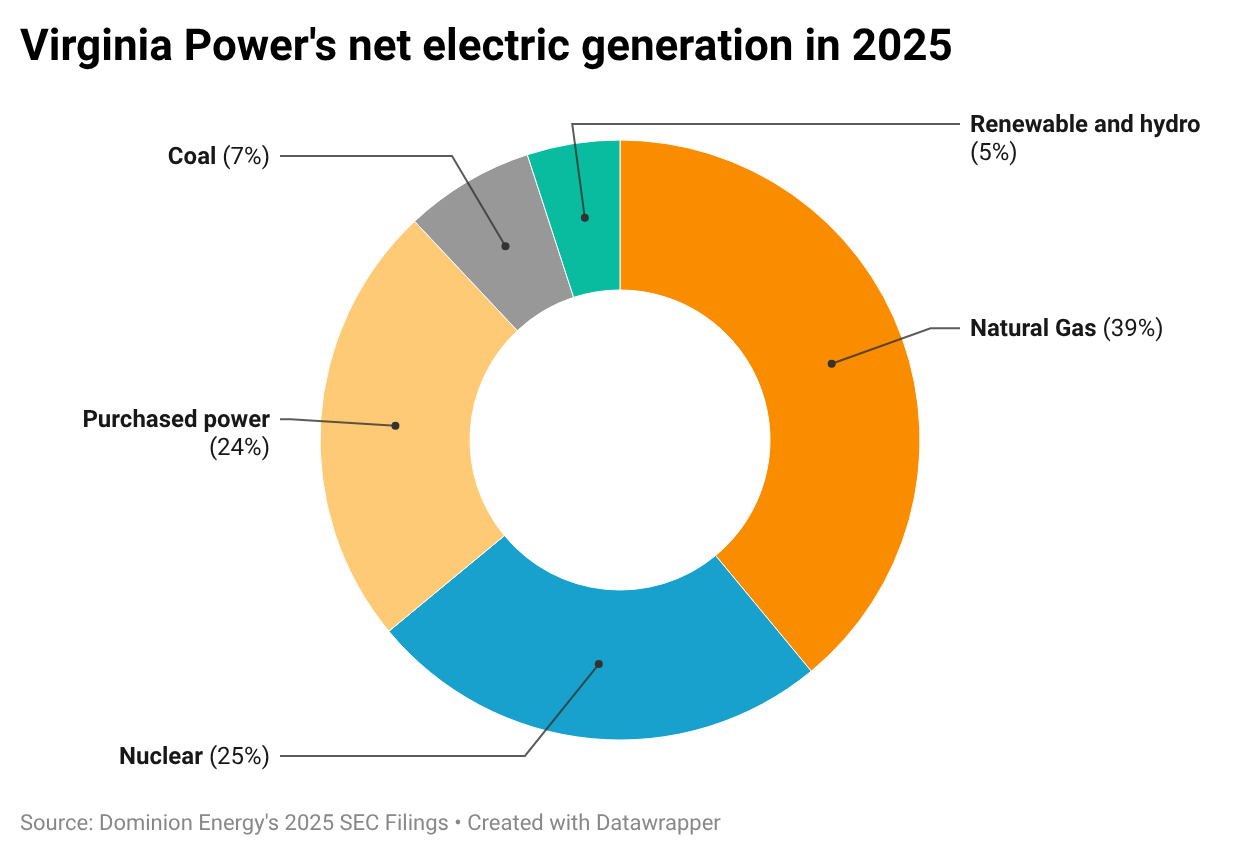
Only 5% of the electricity that Virginia Electric and Power Company generated in 2025 was from renewable energy sources, according to Dominion’s SEC filings. Virginia Power is the name under which Dominion operates as a utility supplier in Virginia and North Carolina.
All the company’s energy assets generated a combined total of 30.7 GW of electricity.
Virginia Power accounted for roughly 60% of the 2025 electricity sales in the Commonwealth in 2025.
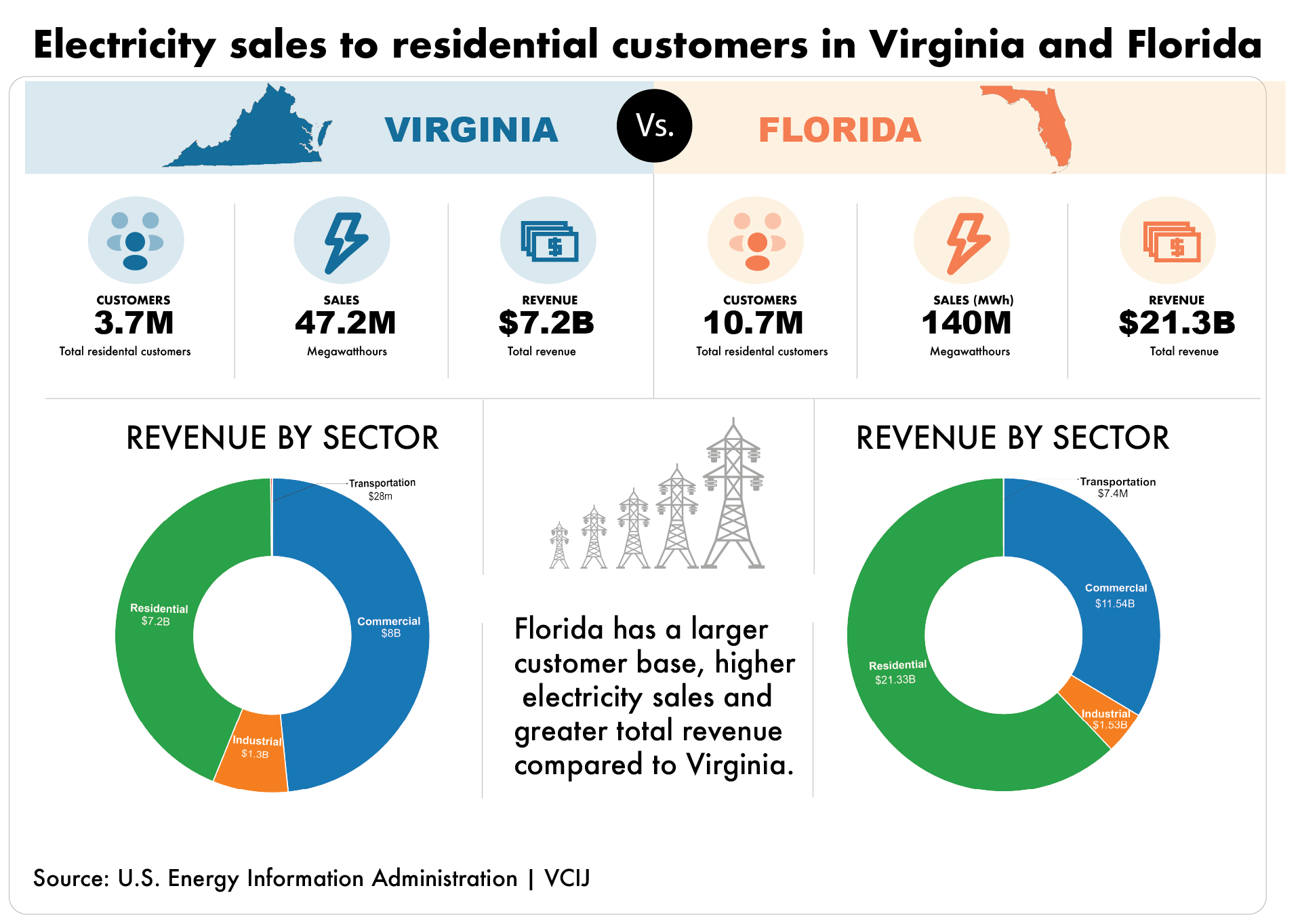
In both states, utilities posted huge revenues. Florida utilities reported $21.3 billion in revenue last year on the sale of 140 million megawatt-hours of electricity. Virginia’s electricity providers, including municipal utilities as well as investor-owned ones like Virginia Power and Appalachian Power, made over $7.2 billion from the 47 million megawatt-hours of electricity they sold to Virginia residents.
Virginia’s Renewable Energy Portfolio Standard requires Dominion to deliver 100% renewable electricity by 2045, and Appalachian Power, a subsidiary of American Electric Power, to reach the same goal by 2050.
While Florida is ahead of Virginia in the use of renewable energy, the NextEra-Dominion deal may not necessarily hasten renewable electricity in Virginia, Ferreira said.
He said that the pace of adoption of how fast the state adopts renewable energy would likely continue to be decided by Virginia lawmakers, he said.
Brennan Gilmore, who heads Clean Virginia, a Charlottesville-based clean energy advocacy group, agreed with Ferreira that the acceleration of renewables in the Commonwealth is in the hands of state leaders.
In fact, he believes the acceleration depends on “removing for-profit utilities like Dominion or NextEra from the driver seat of our energy policy.”
Reach Kunle Falayi at Kunle.Falayi@vcij.org.